

BIG READ: Remembering Canon Hayes - 65 years on

In this week's Nationalist
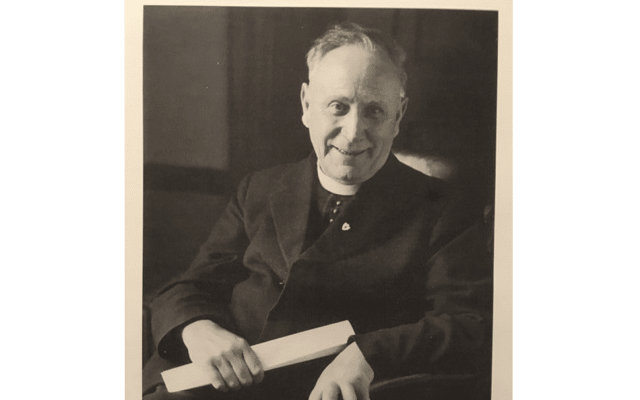
January 30, 2022, marked the 65th anniversary of the death of Canon John Hayes, founder of Muintir na Tíre and Parish Priest of Bansha/Kilmoyler.
It is appropriate therefore to remember this humble man who inspired and galvanised thousands of people into action for the benefit of people and communities throughout the length and breadth of the country.
That he was born in such dire circumstances, in a Land League hut “on the side of the road” as he himself put it, undoubtedly fuelled his determination to improve the lot of rural inhabitants.
If Canon Hayes’ success in that regard can be summed up in a phrase, it might be said that he himself did more than any man in his generation to discover the hidden talents of the ordinary people of Ireland.
By discovering these talents he re-awakened the pride of the people in themselves, a pride that was not excessive or ostentatious, but an awareness of their responsibility to the community and a satisfaction in the realisation of their ability to contribute to some portion of the community effort.
With the coming of that awareness of usefulness to the community, there came to many individuals the sense of community.
With the growth of the community sense, came the urge to harmonious community co-operation and with active and progressively better- informed community operation in effort, came re-vitalised parish living.
The parish therefore represented a mighty asset of inherited strength.
To keep this safe for the nation, to preserve its sterling quality by keeping it sound in all its parts, all co-operating in living organic activity for the good of the parish as a whole, was the ultimate purpose in his founding Muintir na Tíre.
In the days when he travelled the length and breadth of Ireland, passing on his vision and his ideal to other parishes and to other leaders, both lay and cleric, no one could ever accuse him of neglecting his own pastoral charge.
As curate in Tipperary, and later as Parish Priest of Bansha, he combined unremitting effort in his devoted attention to his care of souls.
Those who were close to him would tell of the late-night journeys back to Tipperary or Bansha from meetings of the Commission on Vocational Organisation, from addresses to far flung guilds, from conventions and congresses, so that his daily Mass might be celebrated in his parish church, that his sick might be visited, and his dying anointed.
Year after year he would leave his Rural Week Congress by the nearest available transport, to celebrate August 15 in his own parish.
He would “rest” after the strain of such a Rural Week by taking on parochial duty on a lonely island off the coast, so that a priest-friend might enjoy a well-earned holiday on the mainland.
Ireland will remember him primarily for his work on behalf of Muintir na Tíre and his strong association with Rural Electrification but for others who were privileged to know him it was as a special preacher who graced many ecclesiastical occasions with his God-given eloquence.
They will remember how mightily he laboured to promote the ideals of Muintir na Tíre and such movements as the Pioneer Total Abstinence Association.
Many, whose acquaintance with Canon Hayes was but slight and who met him but briefly, will remember him best as a gifted public speaker. He could reduce an audience to tears with his humility, his gratitude, and his firm belief in the essential goodness of people.
A lasting and rewarding result of Canon Hayes’ life-work was in the growth and expansion of the virtues of charity and neighbourliness as found in the parish guilds and now community councils.
Neighbourliness was a word that was often on his lips. He was insistent on the fact that there was plenty of untapped good-will in people and from that came the progress into voluntary service so that improvements should involve no expense to the community.
For Canon Hayes became the leader that he was, the great Irishman that he was, because of his understanding of the solidarity for “the good of the parish”.
A close friend of his and of his work once described him as “Ireland’s most constructive optimist” - an apt phrase to sum up the man whose optimism helped to change the face of rural Ireland. This is an extract from Fr Seán Corkery who attended the funeral of Canon Hayes in Bansha on February 1, 1957, and wrote as follows:
“I was present at the obsequies. I was an insignificant unit in an assembly that included an archbishop, bishops, superiors of religious orders, hundreds of priests, both religious and secular, An Taoiseach, Ministers of State, the Leader of the Opposition, representatives of national and local government, and thousands of members from guilds of Muintir na Tíre scattered throughout the four provinces of Ireland. The grieving, but courteous, people of the parish made us welcome, were deeply and sincerely grateful for our being there, entertained us with characteristic hospitality, but left us in no uncertainty as to the exact character of the ceremonies which we attended.
“The people of Bansha, in the presence of sympathetic friends, were committing to consecrated clay the remains of a beloved Father. For them, as for us who understood their feelings, it was the funeral, not of the founder of Muintir na Tíre, but of the parish priest of Bansha. It was the youths of Bansha who had maintained the thirty-six-hour vigil over the remains; and when we outsiders left for our far-flung destinations, it was the people of Bansha who remained at the graveside on that day of alternating sunshine and hail-storm, in a very ecstasy of prayer for the soul-repose of their pastor, which, as the Canon himself would say, was exactly as it should be.”