

Ash tree preservation project in Tipperary carrying out vital work
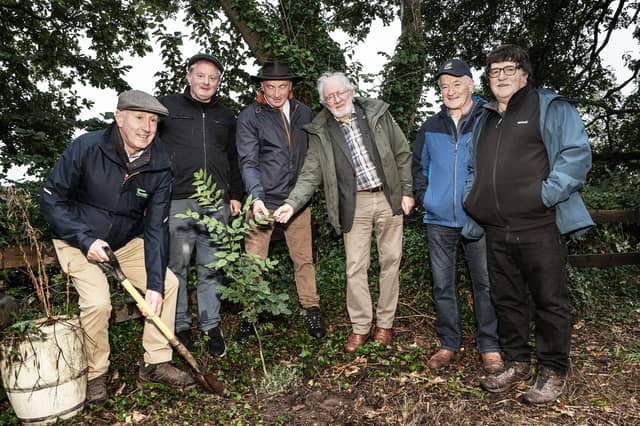

The project is carried out in Mullinahone in conjuction with Teagasc
The Kickham Tree Project started in Spring 2020, before COVID-19 had impacted our lives.
The project is a community-based initiative centred in the south Tipperary village of Mullinahone.
The project itself is a partnership involving Teagasc, the Mullinahone community and Tipperary County Council. Its mission was plain: to conserve several ash trees in the area, promote awareness of biodiversity, and develop an inheritance that began over 200 years ago, when the Bryan family planted trees.
These trees have become part of local folklore through the writings of Charles Joseph Kickham, one of Ireland’s leading literary figures of the 19th century.
Kickham is fondly remembered for penning the ballad of Slievenamon (Tipperary’s county anthem). However, his 1873 novel, Knocknagow,is recognised as his most significant work. Many experts consider it the definitive narrative of Irish peasantry before the Irish land wars of the 1880s.
Kickham and the Bryan Trees
In 1798, the Bryan family planted an array of broadleaf trees on their farm at Gurteen, Mullinahone. This was the year of a major uprising in Ireland, led by the United Irishmen.
Despite early successes, the rising was defeated in September 1798 and contributed to the Act of Union in 1801. Twenty seven years later, Charles Kickham was born in Mullinahone,
The Kickham family were local business owners. Charles was home-schooled, and his parents intended for him to pursue a career in medicine.
His education and later life were greatly affected by damage caused to his hearing and eyesight when a flask of gunpowder exploded in his face in a hunting accident.
However, young Charles was influenced by his parents’ nationalistic political views.
At that time, there was a lot of opposition to the Act of Union in Ireland.
Charles became editor of The Nation.
He would soon become a founding member of the Irish Republican Brotherhood.
His membership of this oath-bound underground organisation resulted in him being sentenced to 14 years’ penal servitude.
Most of Kickham’s prison time was spent in Pentonville Prison near London.
In March 1869, he was released because of ill health.
At the time of his release, the Bryan trees were over 60 years old.
The trees had evolved into a linear woodland intermixed with green pasture.
On his return to Mullinahone, Charles Kickham would walk to these trees on the Mullinahone to Fethard road.
He favoured one massive ash tree and would sit under the tree for hours writing.
After his death in August 1882, that giant ash tree was christened ‘Kickham’s tree’ in his honour.
The tree turned into a local attraction over the next century.
Unfortunately, this giant ash tree was cut down in 1992 for safety reasons.
A stump remained, but this was fully removed in 2009.
The Kickham Tree Project
During the 2019 Kickham festival, a group of locals looked at ways to protect the trees in this area.
The group wanted to preserve the heritage left by both the Bryan family and Charles Kickham.
An idea was born to create a small project to showcase nature, biodiversity, trees and culture with the famous writer at its core.
The local community in Mullinahone contacted Donal Mullane, Regional Manager for Teagasc, Tipperary, for assistance and advice. Donal brought forestry development officer Michael Somers on board to further develop the project.
The project grew into a unique three-step heritage project involving the Kickham Festival Group, Teagasc and Tipperary County Council.
The three steps of the project
The project has three distinct phases:
1. Develop and plant ash trees from the first Kickham stock to identify those that may be resistant to ash dieback disease at the first site.
2. Promote heritage and biodiversity through hedge laying in a style similar to that used in south Tipperary at the time of Kickham.
3. To create an art installation bringing all these separate entities together.
Creating a new Kickham Tree
Ash dieback is a serious fungal disease of ash trees.
It was first noted in Ireland in 2012.
Ash trees around Mullinahone and the surrounding areas have been badly affected by the disease.
Many of the ash forests established since 2000 have been removed.
However, the ash trees planted by the Bryan family years ago appear healthy and disease-free.
These trees were planted alongside the original Kickham tree and probably share the same gene pool. The project will continue to monitor their health status.
To develop the project, Teagasc researchers based in Ashtown, Dublin, were contacted.
The Teagasc Forest Development Department has been at the forefront of research into selecting and breeding ash trees for resistance to ash dieback disease.
Shoots from the ash trees on site were collected in 2020, just before lockdown.
These shoots were grafted onto new rootstocks.
This creates rejuvenated versions of each tree, extending their individual lifespans.
The health status has been monitored.
Over the next two years, they will be ready for planting.
This will be timely for the bicentennial anniversary of Charles Kickham’s birth.
Hedgerows
Back in 2020, the hedges surrounding the Kickham tree site no longer fulfilled their basic function as a livestock barrier.
Species such as elder had taken over.
While recognised as a good species for wildlife, elder creates holes in hedges, and eventually the hedge will lose its dense base and will not be useful for stock-proofing.
At the time, it was decided to lay both hedges at the site to create a livestock barrier, promote a healthy hedge and encourage biodiversity.
Now, six years after its restoration, the hedgerow is fully established and entering its long-term maintenance cycle.
The original horizontal ‘pleachers’ (the bent stems) have sent up thousands of vertical shoots.
They have knitted together and formed a dense base.
The binding stakes are slowly decaying.
This is a natural process, and the deadwood is providing its own unique ecosystem for insects.
The hedge is ready for its first hedge cutting.
Commenting on the restored hedgerow, Pádraic O’Leary, Teagasc Forestry Development Officer, said: “The Kickham Tree Project shows how the management of trees and hedgerows can support biodiversity while also preserving an important part of the area’s cultural heritage. The success of the hedge laying can now be clearly seen in the dense growth that has developed from the original pleachers. Appropriate ongoing management will help retain that dense structure and ensure the hedgerow continues to provide shelter, a livestock barrier and valuable habitat for wildlife. It is particularly valuable to have a project that connects the historic importance of trees in Mullinahone with their practical management today. It provides a strong example of what can be achieved when a local community, landowners and public organisations work together.”
Teagasc Forestry Development Officer Pádraic O’Leary will continue to provide local advisory support as the Kickham Tree Project progresses towards the planting of the rejuvenated ash trees and the bicentenary of Charles Kickham’s birth.
Pádraic can be contacted by phone: 083 841 1097, or email [email protected].