

Tipperary and Kilkenny county councils cooperate on repairs to damaged Killonerry bridge
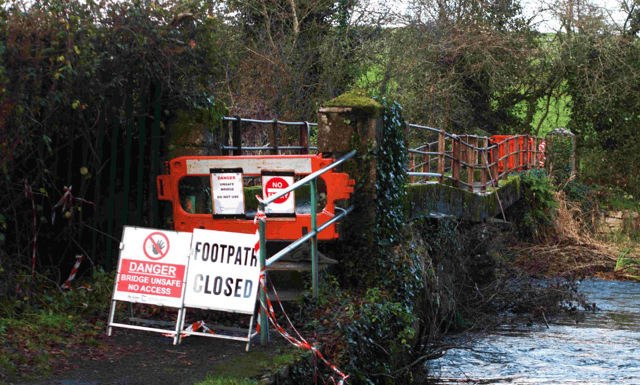

Both the county councils of Tipperary and Kilkenny have agreed to work together on a funding application for the damaged Killonerry bridge, which was damaged in flooding of the River Lingaun in 2025
Both Tipperary and Kilkenny county councils have agreed to work together to apply for funding for the damaged Killonerry bridge, a pedestrian footbridge that crosses the River Lingaun on the county border.
The bridge was damaged in November 2025 due to flooding; subsequently the damaged section on the Kilkenny side has been removed, while access on the Tipperary side has been fenced off to protect the public.
In an announcement made late last week, the Council announced that both councils are working towards a joint application for funding under the Outdoor Recreation Infrastructure Scheme (ORIS), and Kilkenny County Council will lead the project.
The proposal, said the Council, builds on the established working relationship between Carrick-on-Suir and Piltown Municipal Districts, which, as adjoining Municipal Districts in neighbouring counties, meet jointly to discuss issues and projects of shared interest.
“This provides an important forum for members and officials from both areas to work together on matters which cross administrative boundaries and to develop a coordinated approach to support communities and address infrastructure challenges collaboratively.”
“Killonerry Bridge is a particularly appropriate example of the value of this collaboration. The bridge crosses the county boundary itself, and its repair therefore requires both districts to work together to put in place a practical arrangement for progressing the project.”
The bridge forms part of the South Leinster Way, the 104km long-distance walking route running from Kildavin in County Carlow, through County Kilkenny and onwards to Carrick-on-Suir.
The route also forms part of the wider European E8 walking route. Records indicate that the pedestrian bridge at Killonerry dates from the 1930s.