

Great turnout at historical tour of Thurles


On Saturday last, 25 January 2020, almost 100 people gathered at the Source Arts Centre to partake in a walk through the history of Thurles town one hundred years ago.
The event, organised by Tipperary in the Decade of Revolution history group, marked four significant events that took place in Thurles town in the early stages of the War of Independence.
Addressing the assembled gathering on the steps of the Source, local historian and author and convenor of the event, Seán Hogan, emphasised the non- partisan and non-political ethos of the group. He called for knowledge and understanding of our history and respect for different perspectives among participants, which included descendants of families involved.
“We are here as historians to tell the story of the Decade of Revolution as accurately as we can. However, we are asking you to remember that people may have different interpretations of what our common history is, depending on their background. We ask that each person attending respects that there may be very different views here, and recognise that the person beside you might not share your outlook on the events that we are talking about here in Thurles, this afternoon.”
The walking tour introduced the RIC in Thurles and their two barracks in the town and on the other side the headquarters of the Mid-Tipperary IRA Brigade at Michael O’Connell’s pub in Liberty Square.
It took in sites of four significant events of the War of Independence in Thurles town.
On June 23 1919, the first deliberate assassination of a high-ranking police officer took place just off Liberty Square, at Parnell (New) Street, when District Inspector Michael Hunt was shot dead as he was returning to town from the local race meeting.
On January 20 1920, Constable Luke Finnegan was shot and fatally wounded as he returned to his home at the Mall.
This shooting was to provoke a violent reaction from Constable Finnegan’s colleagues, who attacked the homes of prominent Sinn Féin figures with rifle fire and grenades that night. The retaliation by the Thurles police was to bring international attention to Thurles.
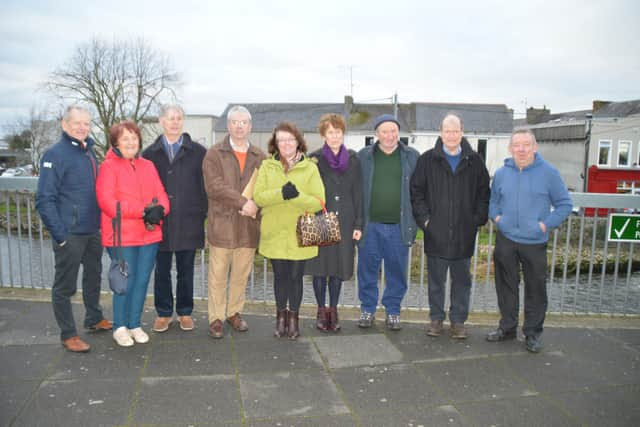
Relatives of Constable Luke Finnegan, shot in Thurles, January 1920; Eileen and Leo Finnegan (second and third from left), from Williamstown, Galway, cousins of the slain constable. Mary Walsh and Maureen Rowan (fifth and sixth from left) grandnieces of Luke Finnegan
Under pressure in the House of Commons, British Prime Minister David Lloyd George’s response to the incident implied understanding and tacit approval of the retaliatory reaction by the police.
This was to set the tone for the remaining 18 months of the War of Independence and the pattern of IRA outrage, followed by Crown Force reprisal that would characterise the mayhem that ensued until a truce was called in July 1921.
On the other side, the tour saw the house of the McCarthy family at 5 Fianna Rd which was the scene of one of the first cases of a retaliatory killing by the police. It was here, on the night of March 27 1920, that local IRA Volunteer, James McCarthy was shot dead when he answered loud knocking on their door.
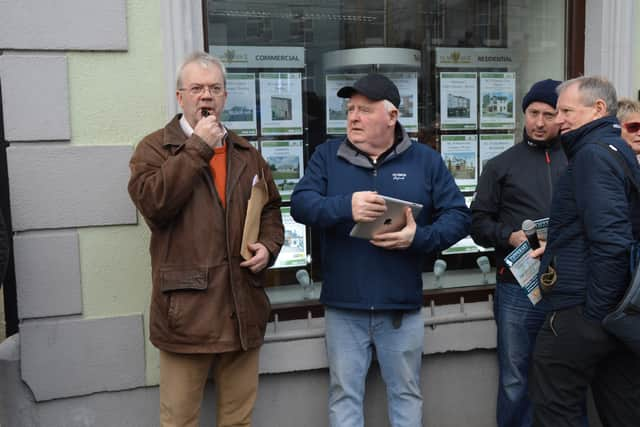
Sean Hogan with local historian Paddy Loughnane
Denis Morgan was grandfather of Dermot Morgan, better known in modern times as actor and comedian “Fr Ted”.
The event was greatly enhanced by the contribution of local historian in Thurles, Paddy Loughnane, whose vast knowledge of the geography and buildings of the town as well as personalities of the time added much to the occasion.
Martin Nolan from Nenagh read extracts of primary source material from the archives, pertaining to those tragic events. Martin Manseragh, Vice-Chair of the Government’s Expert Advisory Group on Commemorations also briefly addressed the gathering, complimenting the inclusive and comprehensive event as a model for how we should remember the frequently difficult events of the Decade of Centenaries.
The walk finished back on the sidewalk of the Source Arts Centre, overlooking the River Suir. Here, as a gesture of remembrance, the walkers were invited to throw a flower, representing a person involved or affected by the events of 100 years ago, into the river.
After a moment of silent reflection, descendants of those that died at the hands of Crown Forces as well as kinfolk of Constable Luke Finnegan who was shot on the opposite bank of the river, took part in this small but moving ceremony, watching the flowers being swept downstream by the strongly-flowing waters of the River Suir.