

'Old soldiers never die' - Remembering the iconic Kickham Barracks in Clonmel
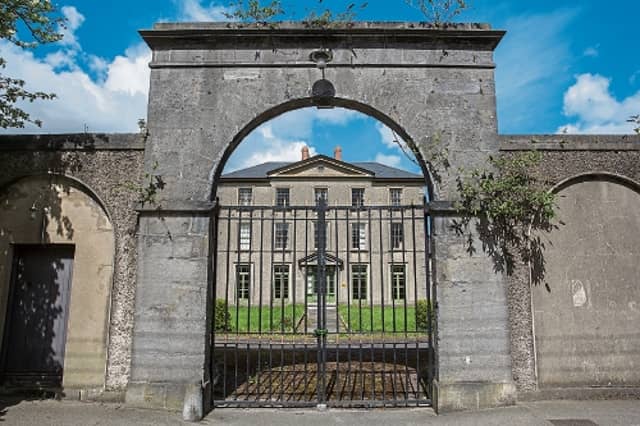

Big read in this week's Nationalist
Written by JJ Killian, a Commandant who served as Commanding Officer of Kickham Barracks from 1984 to 1988.
Those currently passing Kickham Barracks will see the commencement of the planned development there.
Old buildings are being torn down in preparation for new growth. One accepts that change is inevitable but some of us will see this initiative as not just a construction project but as the burial rites of the military history of this town.
Built between 1780 and 1782, the Clonmel Infantry Barracks, home to various regiments, was later renamed as Victoria Barracks.
Kickham Barracks is actually comprised of two barracks as an artillery barracks was built adjacent to the original infantry barracks.
The post saw plenty of action during the Civil War but it was then taken over by the Board of Works in 1927.
The barracks was occupied by the 1st Field Engineers in 1941, the unit which rebuilt many of the damaged buildings.
It was then garrisoned by the 13th Infantry Battalion until a reorganisation of the Defence Forces in 1956 saw the barracks becoming the home of two companies of the 12th Infantry Battalion.
I was posted to Kickham Barracks, on being commissioned, in September 1969. I was initially confused by the local greeting of “well” (well, what?) and by the sheer number of Ryan’s in the barracks.
The army had a way around everything – the many Ryan’s were differentiated by using the last two digits of their service number – so I got to know “55 Ryan”, “38 Ryan”, “16 Ryan” and many more without ever becoming familiar with their Christian names.
The 13th Infantry Battalion, a unit considered to be one of the finest in the Defence Forces, was still fondly remembered and the personnel here, now members of the 12th Infantry Battalion, considered themselves to be a cut above the rest.
I initially saw this as being slightly arrogant but I would go on to serve with these men in a wide range of military operations both at home and with the UN and I can confirm that these were proud soldiers who were definitely a cut above the ordinary.
So many fine men who wove the tapestry of Kickham Barracks and who have now mostly marched into history.
A young officer joining an active unit after two years in the Military College is like any person leaving college to start their first job – the former never prepares one for the latter.
My experience mirrored that of every young officer around the world – my real education was at the hands of experienced NCOs whose sage and timely advice kept me on the straight and narrow.
My initial sojourn in Kickham Barracks was short-lived and I was to spend a lot of time on anti-terrorism operations all along the border from Donegal to Dundalk.
The country was simply not prepared for the circumstances imposed by The Troubles and the Defence Forces personnel who engaged tirelessly in border operations often worked and lived in appalling conditions – it is to the credit of all concerned that everybody just got on with the job.
But, as with the first tours of duty to the Congo, the Defence Forces were found to be unprepared.
We were eventually issued with combat uniforms. Shortly afterwards, I was monitoring a patrol in a village which straddled the border when I was accosted by a woman on the street: “we don’t want the f**king British Army here”, she shouted. I explained that, actually, we were the Irish Army – to which she retorted “f**cking Free Staters!” It’s hard to win sometimes.
The Defence Forces were not ready then and are certainly not ready now. Indeed, our whole stance on defence has deteriorated to the point where the organisational structure of the Defence Forces is not capable of carrying out its stated roles.
This situation has resulted from serial neglect by successive Governments and a continued reduction in defence spending as a portion of GDP – if this reduction continues on its current path over the next ten years, then defence spending will equate to zero and we will not have a Defence Force. Our national attitude to defence has always been ambiguous.
The stance taken by de Valera on neutrality was, to my mind, an act of expediency which has since unduly influenced our approach to taking our place in the world as a sovereign nation.
Being “neutral” (some would say “neutered”) allows us to sidestep a strategic question for now but, in the meantime, our military capability is being seriously diminished while our Defence Forces leak corporate memory. It is simply not sufficient to describe ourselves as neutral – neutrality has to be defended. Ireland does not have a coherent defence policy.
As a country, we have no air defence capability – when Russian military aircraft currently enter Irish air space, our deterrent consists of RAF fighters scrambling from UK bases.
Increased Russian submarine activity highlights the fact that we are incapable of protecting aspects of our national infrastructure such as the transatlantic fibre optic cables – our Naval Service has no ability to deter such maritime intelligence gathering.
It is common knowledge that our Naval Service cannot even put all its ships to sea because of the lack of qualified crews.
Ireland lacks the radar facilities to monitor our national space, the naval resources to monitor our territorial waters and other necessary interdiction capabilities to deter any form of external aggression or interference.
This country hosts the European headquarters of many of the world’s leading technology companies and is estimated to hold over 30% of all EU data – yet, its lack of capacity in the area of cyber defence leaves it vulnerable to cyberattack.
Those passing Kickham Barracks may see its demise in socio-economic terms, such as in the loss of a factory, and, indeed, jobs have been lost – although not in the Department of Defence!
The ratio of civil servants to soldiers in Finland (where they take defence seriously) is 1: 254 whereas in Ireland it is 1:25!
What are they doing? They are certainly not maintaining a workable defence system. One can pass the barracks and shrug one’s shoulders – the town is well supported by multi-national corporations – a result of our questionable policy on foreign direct investment (FDI) but that is a topic for another time.
Younger people who stroll by the barracks railings will probably have little appreciation of the history which has unfolded here since the time of Cromwell.
The people of Clonmel served the town well then and they continued to do so over the following centuries.
The men with whom I served wrote their own little chapter while being great characters.
Those same men were fond of using nicknames, as is done in every army, so some were tagged as “Tex”, “Farmer”, “Knox”, “Rubber”, “Blacky”, “Bat”, “Horse” “Killer”, “Peewee” and many, many more. I can only thank them, and their families, for their loyalty, their pride and their service.
The sound of hundreds of polished boots pounding the parade ground will never be heard again.
That square will become a plaza which will not remember what went before.
But as long as anybody who has ever had any connection to Kickham Barracks remains alive, so the memories of those great soldiers will remain alive.
Old soldiers never die.