

INTERVIEW: Tipperary International Peace Award winner Giles Duley

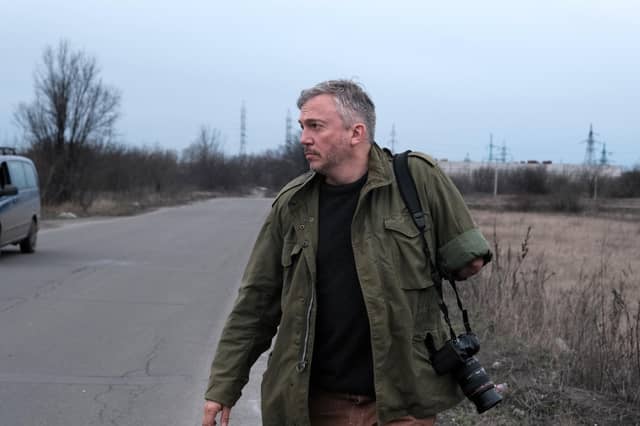

‘Most of my work has been documenting love, not war’
Over two decades, British photojournalist and humanitarian Giles Duley has travelled to some of the world's most dangerous conflict zones, documenting the lives of ordinary people. In recognition of his work, Giles is to be year’s recipient of the Tipperary International Peace Award.
His work has taken him from Afghanistan and Iraq to Ukraine, Rwanda, Lebanon and South Sudan, Bangladesh and beyond, where his photographs have focused not on the violence itself, but on the resilience and humanity of people caught in the grips of armed conflict.
His own life changed forever in 2011 when he was critically injured after stepping on an improvised explosive device while working in Afghanistan, losing both legs and his left arm. Remarkably, Giles returned to Afghanistan just 18 months later to continue his work.
Giles has since established the international charity called the Legacy of War Foundation, founded in 2017. It provides localised, sustainable, and community-led support to civilians affected by armed conflict, helping individuals rebuild their lives through physical, psychological, and economic programs.
In recognition of his work as both a photographer and peace advocate, Giles Duley has been named the recipient of the 2025 Tipperary International Peace Award. The honour, which has previously been presented to global figures including Nelson Mandela, Mary Robinson, Malala Yousafzai and Ban Ki-moon, will be formally awarded at a ceremony in Tipperary this September.
Early Life
When Giles was a young boy he received two seminal gifts that would alter the outcome of the rest of his life, even if he did not know it yet. After the passing of his godfather, he was gifted an Olympus OM-10 and a photography book by Don McCullin, the legendary British photojournalist.
"I had never really seen images like his before," Giles said in conversation with the Tipperary Star.
"My parents weren't that interested in the arts or media. I had never gone to galleries, so suddenly seeing these really stark black-and-white images made me feel so much emotion. To see his images of the war in Vietnam especially... it didn't matter what chaos was happening in the image, you would always see the expressions in a person's eyes. It just drew me in.”
As a child, Giles explains that school had been a difficult experience for him.
“I am dyslexic I always struggled in school. I was held back a year at one point when I was like 12 years old. School had been a real struggle for me. Nobody had diagnosed or spotted that I was dyslexic and so I just always thought I wasn’t able to communicate in the way that I wanted to.”
“Seeing these photographs was like experiencing a different language, visual storytelling really worked for me... it was like I could speak for the first time” he said.
Finding Purpose
Before becoming a humanitarian photographer, Giles Duley enjoyed a successful career in music photography during the 1990s. Working for magazines including Q, Select, GQ and Esquire, he photographed some of the biggest names of the Britpop era, including Oasis, Pulp, The Prodigy and The Charlatans, as well as international stars such as Mariah Carey and Lenny Kravitz.
Despite the success, he felt unfulfilled in his work. "I left music and what I call the rock and roll years," he said. "I moved down to Hastings, got a job in a pub and was very lost. I thought I had messed everything up."
Everything changed when he became the full-time carer for Nick, a young man with autism. Giles would work for two years as Nick’s full time carer, a period in his life which he describes as giving him back his sense of purpose. "Photography up until that point had been about making photographs and making money. What I learned with Nick was the power of purpose."
With Nick and his family's permission, Giles began documenting his daily life to help the healthcare professionals better understand the challenges Nick faced.
"It was a eureka moment for me," he said. "I realised photography could be used to advocate for someone." That experience shaped the philosophy that still guides his work today. "I do not give anybody a voice. They all have voices. My job is simply to amplify those voices."
Love Through The Lens
When Giles first began documenting communities affected by war, he believed his photographs would focus on suffering. "When I started, I had this unconscious bias where I would show people looking sad or in pain," he said. But the longer he spent with families living through conflict, the more his perspective changed.
"What I tended to find was laughter, kids playing, families sharing a meal, couples in love holding hands. In the midst of war I found the greatest stories of love that I could imagine."
Rather than seeking dramatic images, Duley now looks for the quiet moments that reveal our shared humanity. "Now what I photograph is a grandmother brushing a grandchild's hair, a father doing lessons with his kids. Moments of love and intimacy that we can all relate to."
He admits it was not what he expected when he set out to follow in the footsteps of photographers such as Don McCullin and Sebastião Salgado. "What I didn't expect when I became somebody documenting the impact of war was that most of my work would be documenting love."
Peace Award
"When I looked at the list of previous winners I had a lot of imposter syndrome. I think I checked about three times to make sure I had actually won it" says Giles. Reflecting on the life-changing injuries he sustained in Afghanistan, the photographer said his recovery taught him an important lesson.
"When you feel overwhelmed, you tend to do nothing," he said. "I learned not to focus on the things I couldn't do, but on what I could do each day."