

Templederry remembers Daniel Carroll who was killed on Bloody Sunday in Croke Park

Daniel and thirteen other innocent civilians lost their lives - he died two days later in Jervis Street Hospital and is buried in Glasnevin Cemetery, Dublin.
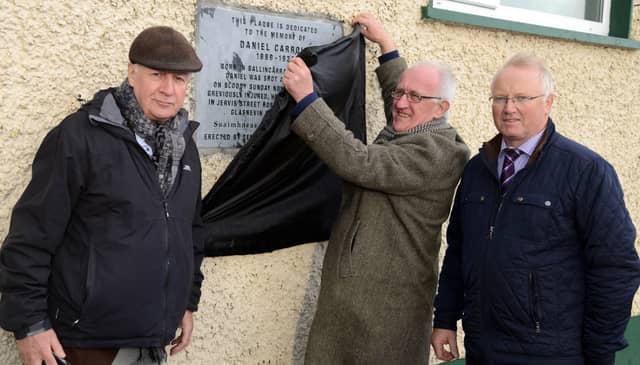
On Sunday December 8, a plaque was unveiled at the Kenyon Community Centre Templederry to remember Daniel Carroll, who was shot at Croke Park on November 21 1920 on what subsequently became known as ‘Bloody Sunday’.
In attendance at the event were Daniel’s grandnephews Paul and Stephen Brennan, members of the extended Carroll family, parishioners, local GAA personnel and representatives of the Tipperary Football Committee.
Daniel was born in 1889, a short distance from the village of Templederry in the townland of Ballincarra, to parents Michael and Bridget. One of four siblings he had a sister Mary (May) and two brothers Denis and Joseph. His father Michael died suddenly in 1897 leaving Bridget with four young children under the age of twelve. In 1912 the family sold Ballincarra and moved to Clonliffe Road in Dublin. Daniel served his time to the bar trade and was manager of Kennedy’s Public House Drumcondra at the time of his death. On that fateful day, November 21 1920, Daniel went to see his native county Tipperary play Dublin in a challenge football match in Croke Park. In apparent retaliation for IRA attacks in the city that morning, which saw the deaths of British agents, a contingent of British military forces entered Croke Park, as the game was in full swing, opening fire on players and the assembled 5,000 plus spectators. As a result of this incursion Daniel and thirteen other innocent civilians lost their lives. Grievously injured, Daniel died two days later in Jervis Street Hospital and is buried in Glasnevin Cemetery, Dublin. He shares his resting place with his mother who died in 1913 and his only sister who died in 1963 aged 77 years.
The plaque was unveiled by Paul and Stephen Brennan, grandsons of Joseph Carroll who was Daniel’s youngest brother. Paul spoke about how Daniel became an unwitting part of a major event in Irish history one that had a bearing on future developments. ‘Dan himself was a quiet man who just found himself in the wrong place at the wrong time’.
Addressing the gathering Denis Hayes, chairperson of the local GAA Club, spoke about how for a long time most of the casualties had been mere statistics of ‘Bloody Sunday’. ‘It is only right and fitting that they are remembered for who they were, where they came from and the tragedy that befell their families’. He also thanked Templederry Kenyon’s GAA Club for erecting the plaque in Daniel’s memory.
May God have mercy on his soul and on those of all who died so tragically due to the events of that day.