

Cabragh Wetlands: The yellowhammer facing extinction?
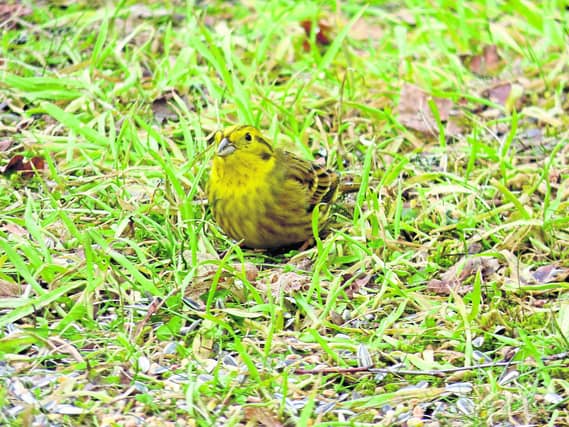

This once common bird has almost vanished completely from the Tipperary landscape.
At this stage, Heritage Week is in full swing with children and families squelching through or perhaps paddling around Cabragh Wetlands being amazed by the bird ringing skills of Aine Lynch or the amazing world of the swift as displayed by Ricky Whelan.
At the same time in Dublin, Cabragh Wetlands along with the Tree Council and Biodiversity Ireland are bringing the wonder and awe of Irish nature to thousands of visitors associated with the world hosting of families.
The events of heritage week give much joy to a very wide range of people but it also has a far more serious side, particularly from the aspect of natural heritage and that is the eternal challenge, since the ice age land bridges gave us our flora and fauna, of accommodating man, agricultural demand and progress, world food supply, shelter etc.,etc.., with the finite resource that is planet earth.
On his recent visit, President Michael D Higgins spoke of the need to achieve a new symmetery in this area. One approach is to refuse to accept any scientific evidence, to fly in the face of proven knowledge and to return to the basic idea that the world was created or evolved solely for man’s use, that is the man of today, ignoring the generations to come.
At times, Ireland too, can have its head buried deep in the metaphorical sands. The ongoing dispute about summer hedge cutting is a typical example of this.
So let’s look this week at a once common bird that has almost vanished from the Tipperary landscape and beside which we may soon have to place that dreaded word “extinction” and unfortunately it is happening on our watch.
The yellowhammer has been in many ways, the canary in the coalmine. A member of the bunting family, its bright male colours are typically seen on posts, wires and hedgerows as it sings its territorial song from its 60 m of hedgerow up to 7,000 times a day from late February to August or even September warning other males where his territory is. The male yellowhammer is more yellow than any other bird except the yellow wagtail and in summer his head is almost totally bright lemon yellow. His underside is also yellow but with a brownish breast band and a few brown streaks on the flanks. His upper parts are chestnut and attractively marked with black and brown except for the rump.
All yellowhammers, whatever their age or sex, have a chestnut coloured rump. Young birds and females are much less yellow than males particularly on the head. The reason for this detailed description is that we would like you to report any sighting to the wildlife officer, Aine Lynch at 087 9369372.
Yellowhammers were familiar farm birds. In winter, you found them feeding on stubble fields and ploughed land mixing freely with larks and finches. They used to flock together at feeding places and if disturbed fly into nearby trees for safety. They eat mainly seeds, especially leftover corn and the seeds of grass and weeds. They also eat blackberries, insect larvae, beetles, spiders and even slugs and earthworms. They nest in almost any country area. Ideally they need open ground for feeding, low scrub for nesting and taller bushes or trees for song posts.
Their favourite habitat is the edge of a young conifer plantation where brambles and other plants are still common. Fields bordered by hedges with some tall trees are quite suitable. Yellowhammers make their nests out of grass and a little moss and line them with hair, fine grass and roots. Most choose a site within a couple of feet of the ground. Some lay eggs as early as mid-April but most start in May. The eggs are whitish or pinkish with squiggles and blotches.
So why is this bird, so long a feature of the Tipperary landscape, now so scarce? Firstly, farming is now a less messy business with less spillage available for birds both on the field and around the storehouse.
Boundaries and other unwanted features such as ponds and patches of scrub that get in the way of machines and reduce the amount of profitable land have been removed. The development of agro-chemicals with more efficient means to spread them between herbicides and pesticides.
Fertilizers increase the density of some crops making them grow too fast to suit skylarks and lapwing. The timing of tilling has also changed especially for winter wheat which has banished winter stubbles, historically superb feeding sites for the yellowhammer and many others. Even increased stocking rates effect ground nesting birds.
While the popularity of oilseed rape has provided opportunities for linnets, reed buntings and wood pigeons, overall the modernisation of farming has been hard for birds to handle.
Cabragh wetlands can help in a number of ways. It is a 200 acre site that does not use any form of chemical and which has a variety of habitats that are allowed to grow wild and produce seeds, flood, turn into mud etc. It can also provide a forum for the type of discussion that is necessary to attempt to solve some of the problems enumerated above.
Soon the children will return to school and even though the pressure on curriculum areas is immense, Cabragh Wetlands, either directly or through the Heritage in Schools Scheme, is there to foster this growing awareness of a child’s environment and nurture that care and respect for it which is now a quintessential part of rearing and growing.
Slán go fóill.