

Tipperary-built racecar heads to Silverstone circuit

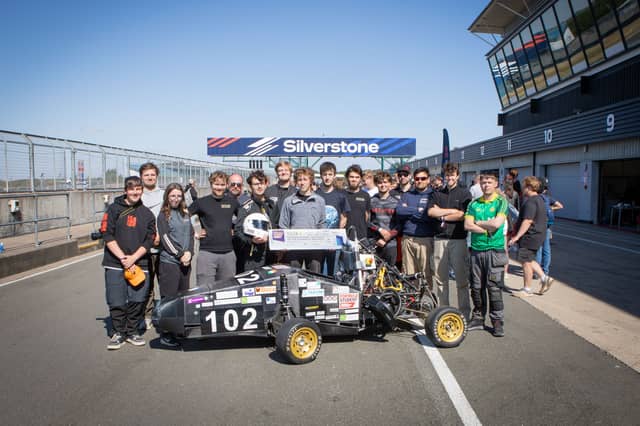

TUS Motorsport recently participated in the Formula Student competition at Silverstone
A group of Tipperary students made it all the way to Silverstone recently, for the Formula Student competition. The team weren’t just Tipperary though, as the car was made right at home in Kilcommon in one obliging set of parents’ shed.
The competition, held recently at the Silverstone Grand Prix circuit in the UK, is open to university students, affording them the opportunity to compete against like-minded engineers and cut their teeth in the world of engineering. The team put in a gargantuan effort over the last two years, working tirelessly through long nights to ensure their car made it to the event.
Speaking with Tipperary Live, team president Nathan Killane explained how the team’s story began in secondary school, where both Nathan and vice-team president Darragh O’Grady became friends during their days in Coláiste Mhuire Co-Ed in Thurles. There, the duo entered the F1 in Schools competition, a challenge which sees students design and manufacture a miniature foam car to compete against other schools. The team brought home an award, and this success directly influenced their third-level choice. The pair saw that TUS was offering the chance to enter the Formula Student competition, giving contestants the opportunity to race full-scale cars that they design and build from the ground up.
Within their first two weeks in the university, they approached Dr Daniela Butan for assistance who duly obliged.
“We kept asking Daniela again and again and again to help us with the team, because it's quite a demanding task in terms of time. We had nothing to start with at the beginning, and the first couple of months we had I suppose maybe six people, five people on the team, and about six months of having not a single part, not a single bolt.”
They spoke with Formula Trinity, the only Irish team competing at the time, who told them that it took seven years for their car to be ready to take to the track. Spurred on from hearing this, the team worked around the clock,
condensing what Nathan believes to be five to seven years of work, down to roughly a year and a half.
Another challenge the team faced was figuring out where the car was to be manufactured. The TUS campus grounds closed their gates at 5pm each evening, meaning the team would be time-limited in their manufacturing process.
Nathan’s parents Eileen and Chris stepped in immediately to offer the use of their shed, which became the team’s manufacturing hub. Eventually the base with fitted with a bathroom, and a bunk bed being fitted in the loft, so team members would need to leave the premises as little as possible.
Eileen, Nathan’s mother, was a key part of the team’s ‘support crew’, and she at times travelled personally with parts for the car to make sure they hit their deadlines. Eileen says the team were the only one that were forced to stop working on their car and leave the pits at 11pm, such was the level of effort and dedicaton they were putting in.
She commended the Kilcommon community for the way they too rowed in. All this effort paid off as officials told the team that if they are to come back next year, having put in the same level of work, they would break the top ten in competition.
PREPARATION
It all begins about two years before the actual competition.
“You start in the very beginning [with] a very specific rulebook from the competition. Building a car was completely new to us; it’s its own type of engineering. There's so many challenges and things you have to learn about vehicles and how to design and why, and there's a very specific path.
"You start with your tyres, the width of the car, the length of the car. You move to your suspension, and then you move to your powertrain and move to your chassis. And it gets designed in a very specific order, for very specific reasons.
"And what we would have done was spent the first eight months to a year heavy in design, designing the entire car, planning the manufacturing of every single part before anything's made, to ensure everything fits together. And we can look at the car then digitally and compare it against the rule book and say, do we reckon we're rule compliant? Are we satisfying each rule and is this car going to work?
"We can simulate parts as well with software to see will they break under pressure, and we can estimate how good the car is first, and then we go to manufacturing. And I suppose the manufacturing really kicked off in January.
The team have suffered practical setbacks too, with customs and delivery delays.
“Our suspension got delayed by 40 days in customs. That definitely was a setback for this year. Something that we've learned this year that we’ll go into much more prepared for next year”.
Dr Daniela Butan explained how the team faced issues with funding. They receive €5,000 initially, which allowed them to buy the tyres, before moving to funding applications of up to €8,000 and then €25,000; without the €25,000, they may not have been able to buy the parts needed to travel to Silverstone. With the rigorous demands of scrutineering to contend with, the TUS car ultimately did not make it to the track, with five of the over 100 entrants contesting the final round of the competition. Not to be put off, the team is due to continue their efforts with the hopes of contesting again next year.
The team wishes to extend their gratitude to all of their sponsors for their continued support over the course of their work, which is “invaluable” to their project.