

Shock results dominate in Tipperary senior hurling championship
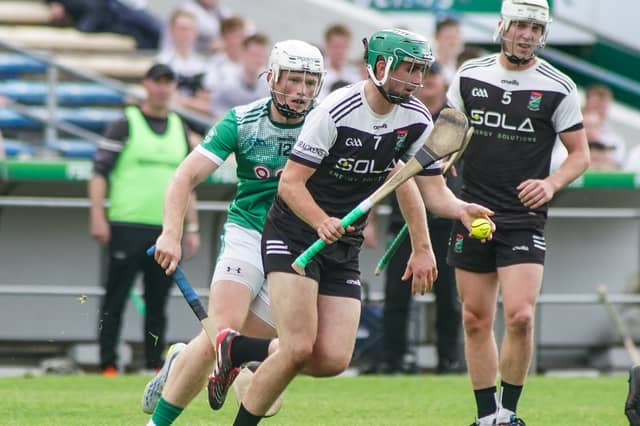

Novel semi-final pairing of JK Brackens and Moycarkey/Borris
It was an eventful weekend on the local GAA circuit with several results raising eyebrows. Unpredictability was the byword as Cashel KC and Borris-Ileigh crashed heavily; Holycross’s rally fell tantalisingly short; Moycarkey’s late swoop did the business.
Plenty of incident then and accompanying excitement as eight became four in the chase for county honours. There will be novelty in the all-Mid semi-final pairing of JK Brackens and Moycarkey/Borris; less so in familiar foes, Thurles Sarsfields and Nenagh Eire Og.
Margins as much as results were key to the shock factor in the county quarter-finals. Who would have predicted a 17-point whipping for Cashel KC at the hands of an Eire Og side minus Jake Morris? It was a stunning delivery by the North side.
This one was over early. Cashel came with high expectations but fell flat in the face of Nenagh’s intensity. Eire Og waded into this contest with a passion that Cashel couldn’t match. Nenagh’s first half was devastating. 1-17 on the board without a single wide showed perfect economy. Cashel were left gasping for air.
The flow of first half points for Nenagh came from a variety of sources as they free-wheeled into an extending lead. Then on the brink of half time Filip Hickey sent Sam O’Farrell through for a cracking finish to compound Cashel’s problems. Devon Ryan alone had shown the necessary resistance for Cashel in that half.
It got no better for the West side. A Ronan Connolly slip let Sam O’Farrell in for a second major shortly after resuming and it was one-way traffic thereafter. Tommy Heffernan’s late goal put an even uglier look on the final figures. Three times Eoghan Connolly drove for goal on frees but the defensive wall held firm. The end margin was a humiliating one for the losers.
This is only Cashel’s second season at senior, so defeat was not the issue. The margin was the real problem. This is a difficult one for the King Cormacs to stomach. Nenagh just swarm- tackled and even their leading players couldn’t break the Eire Og chokehold. Regrouping won’t be easy.
Nenagh made little of their injuries. Jake Donelan Houlihan had to hobble off after four minutes to add to the loss of Jake Morris. But it mattered not. The Heffernans, Sam O’Farrell and Josh Keller led the way but ultimately it was a team effort that just overpowered Cashel.
There was a similar imbalance when Sarsfields and Borris-Ileigh lined up. Jack Bevans hit the crossbar early on and Paddy McCormack brought a save from his namesake in the Thurles goal. These were rare items of hope for Borris’. Otherwise Sarsfields were dominant.
Kieran Rossiter was in devastating form in the first half, scoring 1-4 in that spell and setting up Darragh Stakelum for a second major. They led by 11 at half-time and there was never a suggestion that the gap would close thereafter. An Eddie Ryan goal from a free late in the day was scant consolation for Borris-Ileigh.
The other quarter-finals were tighter and more dramatic. For 50 minutes we watched a game where Kiladangan appeared to have a firm hold on Moycarkey. The North side led by six at half-time after goals from Dara O’Dwyer and Alan Flynn, shots that Rhys Shelly should have done better on. Six was still the margin with ten minutes to play and no real evidence of a Moycarkey revival.
Not for the first time this year, however, there was a late fadeout from Kiladangan. From the 51st minute on they were outscored 2-7 to 0-3 in a stunning turnaround. ‘Kiwi’ Morris was key to the late blitz from Moycarkey. He won possession and fed David Costigan for a smashing volley to the net for the first goal. Then he got behind his marker to deliver a deft little flick for the second, which tied up the game with six minutes to play.
The momentum was now with Moycarkey, who drove home the advantage with a run of points. From the 51st minute on there was a ten-point turnaround, from six-down to four-up. David Costigan took individual honours on 2-4 but Kieran Morris too was central in a display that showed all-round perseverance.
The remaining game produced what was probably the shock of the weekend as championship favourites Holycross went out to JK Brackens. Amid swaying fortunes, Brackens drew first blood, going six-up when Jamie Ormond netted after 24 minutes. Then Holycross put on a spurt and reeled off six unanswered points to tie the match at the break.
The trend was similar in the second half. Lyndon Fairbrother goaled from an Andy Ormond feed and the Templemore lads went seven-up with just five minutes to play. Once more Holycross found a response with six points on the spin, three of them in injury time. Ultimately, they were beaten by the clock and left to rue such a patchy performance.
It’s a major setback for a team that is coming but has yet to find the winning knack at this level. The absence of Cathal Barrett for most of the game was a major setback but ultimately it was their third defeat in divisional and county campaigns this year, so there can be no quibbles. The breakthrough awaits another year.
Elsewhere, two major events drew national focus on the GAA last week. Mary McAleese’s resignation as chairperson of the integration committee sparked major controversy. At the same time John Meyler’s hurling review committee released its interim report on proposed changes to rules. The response has been mixed.
This offering from John Meyler’s committee was eagerly awaited. 8,430 people participated in their national survey, which was significantly more than the football equivalent for Jim Gavin’s review group. Clearly people are exercised by the ills of hurling and want them addressed.
For many of us, however, this report is a massive letdown, failing to tackle some of the core problems and introducing some nonsense items such as increasing the number of steps to six.
The survey results were interesting. Across all groups that responded, the handpass/throw emerged as the number one item of concern, with many backing Conor O’Donovan’s proposal to tackle the issue.
Yet, like a nimble-footed athlete, the committee sidestepped the real issue. Instead, they presented a focus on “a clear striking action” as if it was something novel when, in fact, it’s part of the existing rule. Nothing new there, just repeating a flawed and failed rule that is doomed to fail yet again.
Banning consecutive hand throws will, presumably, reduce their number but it doesn’t tackle the core issue. Ironically, Conor O’Donovan’s suggestion would be far less restrictive and more likely to prevail in the long term.
I understand some people feel that Conor’s proposal is unworkable. Fair enough, but why not trial it, especially since it was already successfully trialed in the Freshers’ League a few years back when it had none of the negative consequences some feared. The missed opportunity here is shameful.
Likewise, the proposals on the cynical foul rule are half-baked. They’ve removed the black card and extended the list of fouls that carry a penalty. Why not make it any personal foul instead of trying to name all possible infractions?
What they failed to do is bring any clarity to what constitutes a goalscoring opportunity, that vague, subjective term which entices widely varying interpretations from referees. Likewise, the zone where the cynical foul rule applies is imprecise and needs clarifying. Yet again the committee fails to deliver here. Controversy is set to continue with this rule.
Elsewhere, the adjustments to the puckout have merit but the six-step change has none. Changes to the ‘65’ rule are affected by pitch size and ultimately unnecessary. A line-ball “cut” is a fine skill but it’s a free shot and lesser in merit than the over-the-shoulder point from the sideline with opponents bearing down.
Overall, I see this report as a major disappointment – a missed opportunity.
Finally, Mary McAleese’s conniption has thrown the integration process into chaos. The ex-President has a point about the GAA dragging its feet but her outburst was over the top and particularly unkind to the management committee, a number of whom are women.
Setting a deadline is all fine and dandy but then it creeps up on you and panic sets in. The GAA has sleepwalked into this problem. Giving overwhelming Congress support to integration is one thing; dealing with the practicalities, financial and otherwise, is quite another.
Our own county is typical. We recently published a five-year strategic plan. You’d expect integration, the biggest GAA development since its foundation in 1884, would feature prominently. It doesn’t.
For starters, the large committee that produced the plan is a male-only body. Not a woman in sight. The document is divided into six so-called pillars, but integration isn’t one of them. The process is mentioned in the section headed Clubs and Communities where “Tipperary GAA pledges to support the GAA’s national integration programme”.
That’s about it. There are lots of platitudes and references to the one-club model (OCM) but no detail on anything. There’s nothing on the dynamics of integration and what’s involved at club, divisional and county level. Not a mention of the financial implications of equality versus equity. It’s no wonder Croke Park had to cry halt.