

People Before Profit’s new Tipperary branch hopes to play the long game

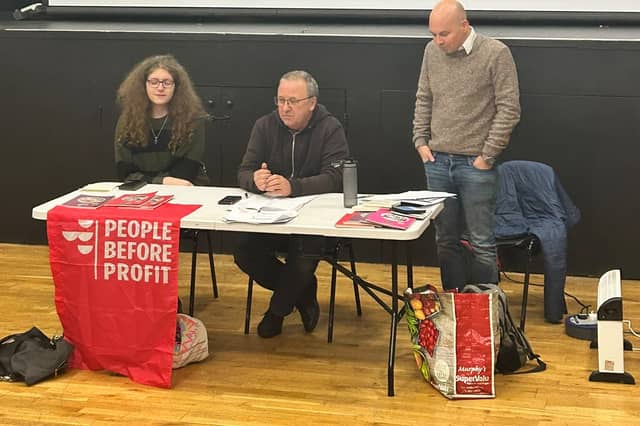

Paul Murphy TD brings People Before Profit to Nenagh
People Before Profit TD Paul Murphy was in Nenagh Arts Centre on Monday, November 16 to launch a new north Tipperary branch of the party.
It was a cold, wet Monday evening which may have contributed to reason for a relatively low turnout of just 13 people. Those who did make it, however, were treated to a lively discussion, with Murphy speaking alongside local organiser Tiffany Green and national organiser Eddie Connolly.
Tiffany, who is from Cloughjordan, explained that the local branch had been formed a couple of months ago. Speaking about the decision to get involved, Tiffany said: “I need to get involved so that if something is happening or if I want to do something, then there will be people backing up other efforts that I can join on to and assist with.”
Tiffany spoke about the importance of connecting the party's wider political aims with the everyday problems facing smaller communities. These included the cost of food and rent, environmental concerns and local developments in the area. Tiffany also raised concerns about the proposed Eastern and Midlands Water Supply Project and what affect it might have on Lough Derg other local waters.
Murphy then covered broader topics like the climate and biodiversity crises, the situation in Gaza, homelessness, child poverty, the cost of living and the Government's proposed changes to the triple lock and the Irish Defence Forces’ operations overseas.
He also spent time discussing the growth of data centres, their demands on the national grid and the role of large corporations in shaping public policy. His central argument was that too many decisions affecting ordinary people are being made in the interests of private profit rather than the public good.
There was certainly no shortage of big political ideas, but some of the most interesting parts of the evening came when the discussion turned to the realities of trying to build a political movement in north Tipperary.
One of the questions posed to Murphy was how People Before Profit could appeal to working-class people who might be more concerned with immediate local issues like potholes, roads, and planning permission rather than with the wider political arguments the party is known for.
Murphy acknowledged that local issues matter, pointing to his own work in Dublin, where campaigning has included everything from playgrounds and pedestrian crossings to school facilities and council rents.
“Most people vote for me because they see me as a fighter for them,” he said, explaining that his work is not limited to the larger national issues that tend to attract attention.
He said that the party could not simply turn up in a town, hold a meeting and expect people to become supporters. Instead, he suggested that it needs to build relationships, identify issues that matter locally and get people involved in campaigns.
The distinction, according to Murphy, is that People Before Profit wants to do more than lobby politicians and wait for decisions to be made. “The difference that we have to offer is people power,” he said.
We don't think that you fundamentally get change by just lobbying. We think you need to exert power. You need to organise people.”
It’s an approach that sounds straightforward enough but putting it into practice in a place like north Tipperary is another matter.
Murphy was then asked why the party has traditionally had a stronger presence in urban areas.
He explained that the left has historically found it easier to organise in cities, where working-class communities and larger workplaces are more concentrated. However, he also pointed to the labour tradition in Nenagh and suggested there was something there that the party could build on.
The problem, he admitted, is getting enough people involved on the ground. He explained that a public meeting on a local issue might attract interest, but unless there are local members willing to meet regularly, get involved in campaigns and keep the momentum going, that interest can quickly disappear.
Murphy suggested that a core group of five or six committed people would be a good starting point for building a branch that could make a lasting difference. He also said the party has a rural caucus looking at how it can expand beyond the urban centres where it has traditionally been strongest.
There was a noticeable Cloughjordan presence in the room, which was perhaps unsurprising given the town's association with environmental activism and the ecovillage. Questions and contributions from the floor reflected some of those interests, including discussion of local renewable energy projects and concerns about the use of resources to support large-scale developments.
When asked what it would take to get a People Before Profit General Election candidate elected in in the area Murphy was fairly realistic, rather than suggesting that a Dáil seat was just around the corner, he said the immediate priority should be to build membership, get involved in local campaigns and establish a recognisable presence.
He felt that a serious local election campaign would be a realistic step forward, even if winning a seat was not guaranteed, he suggested that building a base of people who would still be active after an election, was just as important as the result itself.
There was also an acknowledgement that sometimes a major local issue can provide the opportunity for a party or independent candidate to gain support quickly. However, as Eddie Connolly pointed out towards the end of the meeting, relying on the right issue coming along at the right time is not the most dependable way to build a political organisation.
Connolly said the party wanted to connect “the small concerns of people's lives” with the bigger global problems Murphy had spoken about.
The effort to establish a local branch is certainly a start for the party and Murphy's willingness to come to Nenagh and take questions from a small audience is to be admired, but the party has a long way to go before it can claim any meaningful influence in the area.
Time will tell whether the small gathering that met in Nenagh Arts Centre will be able to keep the momentum and grow a following in an area that is known for being difficult to unseat long-standing politicians and sway people from generational party affiliations.