

People advised not to drink water from famous Tipperary well


Signs warning people not to use the water at St. Patrick’s Well in Marlfield, Clonmel for drinking, washing or cooking were erected after two people became ill after drinking from the well.
The well “was therefore considered a potential causative factor”, according to a statement from Tipperary County Council, which erected the warning signs last week.
The council says the wording on the signage is currently being reviewed.
“However, the signage is likely to remain indefinitely.
“It is not intended to continue monitoring the water from the well, as it is a non-treated source and results only indicate what the quality of the water is at the particular time of sampling”, according to the council.
St. Patrick’s Well is one of Tipperary’s most visited attractions and generations of townspeople and visitors alike have drank the water there, which flows from an underground spring.
People were surprised, therefore, to see the two signs erected in the area.
In a statement, Tipperary County Council said it received a query from the Health Service Executive (HSE) on January 29 regarding whether or not public signage was on display at St. Patrick’s Well, advising that the water at the well was a non-potable source.
“The council understands that this query came about as a result of two people who had contracted VTEC (Verocytotoxigenic Escherichia coli), which is a disease notifiable to the HSE.
“On investigation by the HSE of the circumstances surrounding the two people becoming ill, it transpired that they had consumed water from St. Patrick’s Well, which was therefore considered a potential causative factor.
“Accordingly, the Water Services section of the council undertook to analyse a sample of water from the well.
“The water from the well was tested on February 10 and gave a result of 9 Coliform/100ml and 0 Ecoli/100ml.
“The Drinking Water (Amendment) Regulations 2014 specify certain limits for various parameters in relation to potable drinking water. The relevant limit for Total Coliform is 0/100ml Coliform, which was exceeded in the sample tested on February 10.
“Coliforms are found in the soil and vegetative matter.
“Having reviewed the results of the tested sample and in consultation with the HSE, the council considered that it was prudent to erect signage at the well, advising the public, as a precautionary measure, that the source was non-potable.
“The water from St. Patrick’s Well is not monitored by the council, as it is not a source of drinking water and is not treated or disinfected.
“However, it was tested on this occasion in response to the queries raised and outlined above”, the council’s statement added.
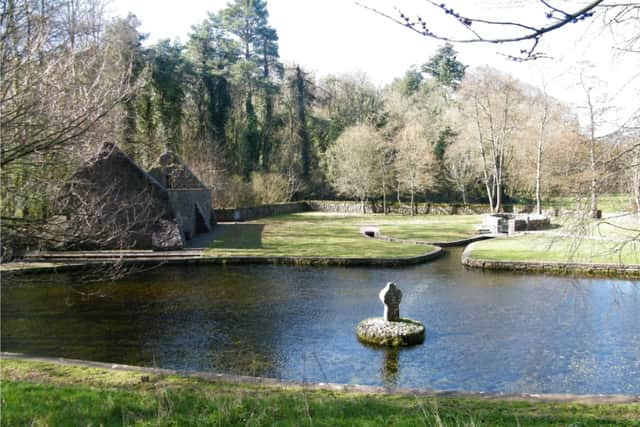
Above - St. Patrick's Well is one of the most popular visitor attractions in Tipperary
The church at St. Patrick’s Well was built in the 17th century, but there are traces of an even older building.
Inside the walls is the tomb of Nicholas White of Clonmel who died in 1622. At the centre of the small lake is a weathered Celtic Cross, which dates from early Christian times in Ireland (possibly the fifth century).
The site is maintained by the St. Patrick’s Day Society and was extensively restored in 1969, with the help of the generous support of Sam Yorty, the Mayor of Los Angeles; Armand Hammer (an American business tycoon) and the Irish Israeli society of South California.
For more Tipperary news read Community shocked and frightened after shot is fired at house in Killenaule