

Wildfire burned close to 1,500 hectares on Slievenamon, council meeting told

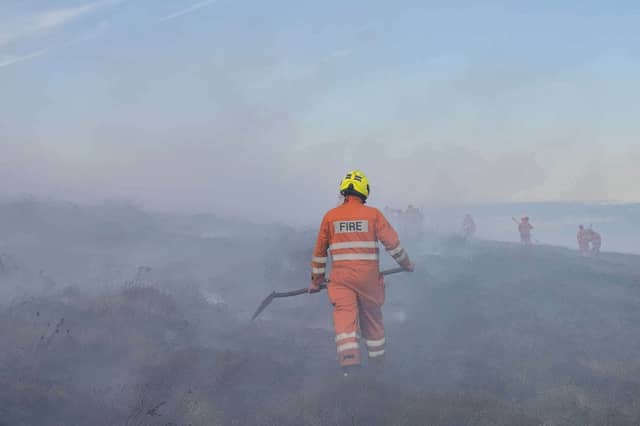

Fire service chiefs gave detailed reports on the emergency services’ response to the Slievenamon Wildfire and its aftermath to Tipperary County Council meeting on Monday
The Slievenamon wildfire burned close to 1,500 hectares of mountainside vegetation and forestry with smoke from it detected as far away as Portugal, but the cause of the blaze is not known, Tipperary's Chief Fire Officer told a council meeting this week.
Tipperary Fire & Rescue Service Chief Fire Officer John Shinners and Acting Assistant Chief Fire Officer Carol Kennedy gave detailed presentations on the multi-agency response to the massive wildfire at Tipperary County Council's September meeting in Clonmel on Monday.
They described how Tipperary Fire Service personnel from Clonmel and Carrick-on-Suir Fire Stations with assistance from Cahir Fire Station battled the fire that raged between July 20 and 28, with flare ups continuing for some time into early August until the record 66 days of dry hot weather broke.
Joining them in the battle were Coillte personnel, the helicopters from the Air Corps and a private helicopter company which dumped loads of water on the flames, and local farmers and contractors, who sprayed roadways and the fire with water brought up to the mountainside in slurry tankers. All were praised at the Council meeting for their efforts.
Mr Shinners informed the meeting that approaching 1,500 hectares of the mountain was burned in the fire. The affected land was owned by private landowners, Coillte and some commonage areas were also impacted.
He was asked by Cllr Siobhan Ambrose if the Fire Service had any update on the fire’s cause and also by Cllrs Mark Fitzgerald and Máirín McGrath in a motion they tabled at the council meeting about the wildfire crisis.
He responded that the Fire Service “genuinely didn't know” the fire's cause as it was spread over such a vast area.
“It took us two hours to get there (to the scene); it's very hard to know how it started. It could be one of any number of causes. We wouldn't be in a position to comment,” he said.
In relation to the fire's impact on water and air quality, Mr Shinners outlined that the smoke from the wildfire was more an issue in neighbouring counties than in Tipperary.
He said he received a call from Cork City about the smoke and smoke from the Slievenamon fire was detected in Portugal.
“A lot of the smoke generated originated from the peat in the bog,” he explained
Meanwhile, he said Uisce Éireann was monitoring water runoff from the mountain for possible contaminants associated with the fire and will take appropriate action to ensure a safe drinking water supply is maintained in the months ahead.
And the River Basement Catchment Service (formerly LAWPRO) is also monitoring the quality of water in rivers and streams in the Slievenamon area in the aftermath of the fire.
Mr Shinnors gave assurance that the stability of the mountain ground remained solid and there wasn't a danger of land slippage or a landslide arising from the fire.
He noted that new vegetation growth was observed in the burnt area of the mountain on August 10.
Both Mr Shinners and Ms Kennedy highlighted how the fire's origins on mountainside terrain that was difficult to reach was a challenge they faced and a factor in its spread.
Carol Kennedy, who led the Tipperary Fire Service response to the wildfire, outlined to councillors that the blaze was first reported on the Ballypatrick side of the mountain at about 8.45am on Monday, July 20.
Clonmel Fire Brigade was mobilised and its fire fighters had to trek for nearly two hours to get to the scene. Carrick Fire Station’s personnel were then mobilised. She recalled that day it took her one and a half hours to get from the bottom of the mountain to the Year Cross around where the fire had started.
Before reaching the scene, she had started mobilising the aerial support needed to tackle the fire in consultation with the National Directorate for Fire & Emergency Management.
The aerial support began on the second day and Coillte brought in personnel in force on the third day. The Coillte people worked with the ground fire fighting crews and co-ordinated the private helicopter.
Ms Kennedy said the fire service obtained a specialist Polaris all terrain vehicle for fighting wildfires from Carlow Fire Station to assist them and also received the help of local farmers and contractors who supplemented their water spraying.
She said the fire had reduced by July 26 but they weren't getting the rainfall to help with extinguishing the fire. They expected to get hotspot flare ups and there was a big flare up in the Killustry area behind Fethard reservoir on August 2 and fire fighters fought it into the early hours of the morning. The mountain needed to be monitored for a long time after because there was no rainfall.
She said the military were on stand by during the crisis but they didn't need them because of the feet they had on the ground.
She paid tribute to the community in Killurney who gave them the the use of their community hall and thanked all the people who dropped of food for the emergency services personnel.
“The assistance we received from the farmers and people was amazing; the Coillte staff and contractors brought in were unbelievable.”
She also paid tribute to Tipperary County Council staff and councillors for their help and support, the Civil Defence for engaging with the local community, particularly vulnerable residents, and the Gardai, who assisted with road closures.
Ms Kennedy also thanked the local Roadstone Quarry who gave the emergency services access to their water source.
Mr Shinners pointed out that Tipperary Fire Service personnel dealt with 72 emergency call outs throughout the county during the Slievenamon wildfire crisis and 34 of those were outdoor land fires, separate to Slievenamon. They were all dealt with by Tipperary Fire Service or the fire services of neighbouring counties.