

COLUMN: Early signs encouraging as hurling's new rules get first run-out



Plenty to like from opening trial game as traditional skills come back to the fore, but there are still a few issues to iron out
There has been no shortage of debate surrounding the GAA's proposed new hurling rules over the past number of weeks, and while there were plenty of reservations about some of the changes, Tuesday night's opening trial game certainly offered more positives than negatives.
It would be foolish to get carried away after just one game, but there was a lot to like about what we saw between UCD and Maynooth University in Belfield, particularly the greater emphasis on striking, the return of genuine contests for possession and, perhaps most encouragingly, the almost complete absence of rucks.
Maynooth emerged 2-18 to 1-17 winners, but the result was very much secondary to what was happening around the field as the new rules were put through their paces for the first time.
And while some of the changes will undoubtedly need a bit of tweaking, the early signs are encouraging.
Handpassing and the disappearance of rucks
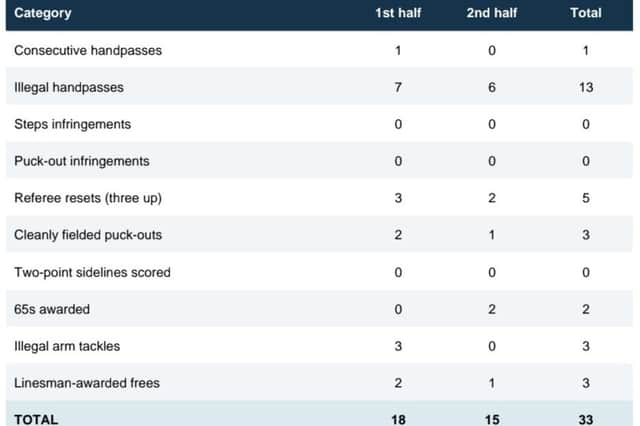
The handpass was always going to be one of the biggest talking points, and referee Chris Mooney certainly wasn't shy about pulling players for infringements, with 13 illegal handpasses penalised over the course of the game.
That is a sizeable number, but considering how much of an issue the illegal handpass has become in hurling, it was refreshing to see the rule being properly enforced. Two of those decisions were actually called by the linesmen, with Mooney's view obstructed by players in general play, and that was another positive to take from the evening.
Referees have enough on their plates as it is, so having the linesmen actively helping out with decisions, rather than simply signalling for sidelines and wides, can only be a good thing. Interestingly, there was just one infringement of the new consecutive handpass rule, which came in the 19th minute, so the players were clearly very conscious of what they could and couldn't do.
But the biggest positive to come from that particular change was the lack of rucks. There was just one clear ruck throughout the entire game. Players were far more reluctant to carry the ball into contact, knowing that they couldn't simply handpass their way out of trouble through a succession of short exchanges.
Instead, they were looking to move the sliotar earlier, and that naturally led to more striking and more genuine contests for possession.
The return of genuine contests for possession
And that was probably the most enjoyable aspect of the game for me. There were some brilliant deliveries into the forward lines, with long, accurate balls creating genuine man-on-man contests inside, and some excellent scores coming as a result.
Forwards were coming out, winning possession, taking on their markers and splitting the posts, and quite frankly, it was a joy to watch at times.
That side of hurling has become less and less common in recent years, with teams now so comfortable in possession that they can afford to bide their time, work their way out of tackles and wait until someone finds a pocket of space.
By the time the ball is eventually delivered inside, it can often be a 70-30 or even 80-20 contest in favour of the forward. There is obviously plenty of skill involved in that approach, but it has taken away some of the genuine battles between forwards and defenders that were once such a prominent feature of the game.
On Tuesday night, those battles were back, with backs and forwards going toe-to-toe for possession, and attackers having to work that bit harder to manufacture their scoring opportunities. It was refreshing to see.
Longer puck-outs and high fielding
The longer puck-outs also played a big part in that, with goalkeepers now required to send the ball beyond their own 45-metre line. There were three clean catches from contested puck-outs throughout the game, which was another very encouraging statistic.
High fielding is one of the great skills of hurling, but it has become something of a dying art with the prevalence of short puck-outs and possession-based systems. There were a few deliveries drilled into space around the half-back line and midfield, but for the most part, the ball was going long, and players were being forced to compete for it.
Delays to restarts a concern
However, this was also where one of the more frustrating aspects of the new rules came into play. There were a few too many delays around puck-outs, with Mooney having to order restarts to be retaken because players weren't positioned correctly between the 20-metre and 45-metre lines.
Under the new rules, three players from each team must be in that area before the puck-out, and while I can understand the thinking behind it, it certainly slowed things down.
The requirement for goalkeepers to wait for the referee's whistle before restarting was another issue, particularly when a team might previously have been able to take a quick puck-out after a wide.
In fairness to Mooney, he was noticeably quicker with his whistle as the second half progressed, and that helped the game flow a lot better. And we have to remember that referees are learning on the job here as well.
They have a whole new set of rules to get their heads around, so it is only natural that there will be a few teething problems early doors. Hopefully, as the trials progress, those delays will become less frequent, because the last thing hurling needs is more unnecessary stoppages.
Six steps a more realistic allowance
The six-step rule was another one that attracted plenty of criticism when it was first announced, but I have to say, I thought it worked quite well. And not necessarily because players were getting an extra two steps, but because it now gives referees a realistic rule to enforce.
The old four-step rule was completely outdated in terms of how the modern game is played.
Quite frankly, how often do we see players taking just four steps before releasing possession, particularly at inter-county level? It very rarely happens, and more often than not, referees simply let players away with it.
We have seen countless examples of players taking eight, nine or even double-digit steps before scoring, and it has become a bit of a free-for-all. At least now, with six steps, there is a reasonable allowance for players to escape a tackle, create a bit of space and get their shot or pass away.
And if they go beyond that, there should be no excuses for referees not penalising them.
There wasn't a single steps free awarded on Tuesday night, and while there were perhaps one or two occasions where players might have exceeded the allowance, the overall discipline was impressive.
Mooney himself commented at half-time that he was surprised by how well the players were getting rid of the ball within six steps, and felt the additional allowance gave them that bit more time to escape a tackle and get a shot away.
For me, that is exactly why the change could work.
Illegal arm tackles
The illegal arm tackle was another area where the players adapted well. Mooney made it clear before throw-in that players could still use their arms when tackling, but they couldn't pull or drag back an opponent's arm to prevent them from getting away.
There were three infringements penalised during the game, and all were fairly clear examples of the offence. And when you combine that with the six-step allowance, it could make a real difference.
Players might find it more difficult to handpass their way out of contact, but they now have an extra couple of steps to escape, while defenders can't simply grab an arm and hold them up. That should encourage players to take on their opponents a bit more, which can only be a good thing.
Longer 65s get the thumbs up
The revised 65 was another interesting one, with Kilkenny's Michael Brennan converting both of the game's awards from the considerably longer distance.
There has been a bit of debate about the fairness of this rule, given that pitches around the country vary in size, meaning the distance from the new position to the posts won't be exactly the same at every venue.
But quite frankly, I don't see that as a major issue.
Both teams are playing on the same pitch, so whatever the distance is, it applies equally to both. And I actually like the idea of making 65s that bit more difficult.
The striking ability of modern players is phenomenal, and Brennan demonstrated that perfectly, with both of his efforts sailing over the bar with plenty to spare.
It just goes to show the distances these lads are capable of striking the ball nowadays.
Two-point sideline cuts
As for the two-point sideline cut, I could take it or leave it. There was only one attempt at a sideline score throughout the game, although playing on an artificial surface was hardly going to lend itself to an exhibition of sideline striking.
I understand the thinking behind rewarding what is undoubtedly one of hurling's great skills, but I don't think it is something the game particularly needs. We had a similar rule 20-odd years ago and it didn't stick around, and I would be surprised if this one survived either.
Plenty to build on
But that is the whole point of these trials. Not every rule is going to work, and there is no harm in trying a few different things to see what improves the game and what doesn't.
There are more third-level league games taking place over the coming weeks, and it will be interesting to see how the statistics develop as players become more accustomed to the changes.
The Hurling Expert Advisory Group is also hoping to stage trial games involving interprovincial teams in the coming weeks, which should give us an even better indication of how these rules might operate at the highest level.
One game is a very small sample size, and there is a long way to go before any definitive conclusions can be drawn, especially in good weather and favourable pitch conditions considering the time of year.
But when you consider that Tuesday night's game produced just one ruck, three clean contested puck-out catches, plenty of quality deliveries into the forwards and some excellent individual scores, there is certainly reason to be optimistic.
The delays to restarts will need to be addressed, and there are a few proposals that might not stand the test of time.
But if the objective is to get players striking the ball more, encourage genuine contests for possession and clamp down on some of the more frustrating aspects of modern hurling, then the opening experiment was certainly a step in the right direction.