

From the classroom to Croke Park: 'Memories last forever,' say Tipperary stars

MARCH 8 IS INTERNATIONAL WOMEN'S DAY 2021
Revealing interviews with two trophy-laden Tipperary stars shows the importance sport has played in making them well-rounded women.
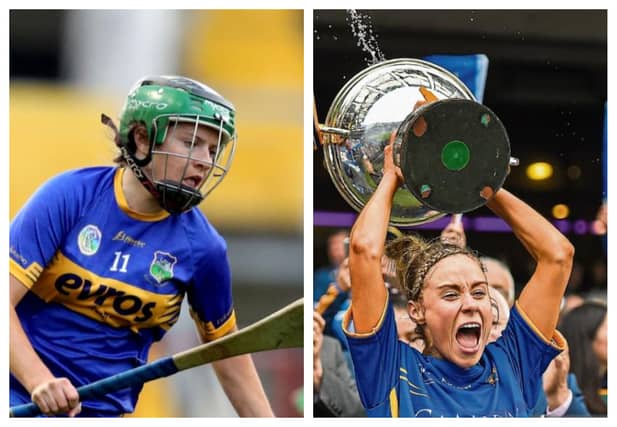
Former Tipperary senior ladies football captain Samantha Lambert recently announced her retirement from the inter-county game, whilst dual player Róisín Howard remains a central figure on the field for the county.
The foundation sport has given both ladies has allowed them to make positive strides in life.
The past Coláiste Dún Iascaigh students welcome recent developments in women’s sport, with Howard also noting that there are areas that still need to be improved.
‘MEMORIES LAST FOREVER’
Sport was a “huge” part of Lambert’s life growing up.
She says balancing sport with her education and spending time with loved ones was “vital” to her success.
“Growing up I was always competitive, eager to learn, and determined to improve both on and off the field,” says the Ardfinnan player.
“Sport taught me values such as resilience, honesty, leadership, excellence and ambition. Organisation is also key to being a successful sportsperson.
“It was vital to maintain a balanced lifestyle. Having the support of my family and friends was crucial for me,” she says.
Lambert says it was a “huge honour and privilege” to represent Tipperary at underage and adult levels.
“Captaining the Tipperary ladies football team to All-Ireland glory in 2017 and 2019, and walking up the steps of the Hogan Stand [in Croke Park] to collect the Mary Quinn Memorial Cup, certainly was a dream come through for me and one of my proudest moments,” she says.
“The opportunity to play with some of the best players in the county and develop lifelong friendships along with unbelievable memories is what I’m most appreciative of. As they say, ‘trophies carry dust, memories last forever’,” Lambert smiles.
An Irish and Geography teacher at Comeragh College in Carrick-on-Suir, Lambert encourages her students to believe in themselves and drive for success in their own lives.
“I try to demonstrate to students how you can be successful in sport and education once you are willing to give commitment and an honest effort to both aspects of your life. It takes a lot of organisation and hard work, but it can be done. Playing sports during the school years is very beneficial, so I encourage students to participate as much as possible,” she says.
Lambert adds that it’s positive to see the cultural shift in the perception of women in sport.
“There has been a huge emphasis put on increasing media coverage, female participation, and attendance at games and events in recent times, which is very encouraging for younger generations. Hopefully, sooner rather than later we will be on par with our male counterparts,” she adds.
‘VERY SPECIAL FEELING’
Howard was an “outgoing, happy go-lucky girl who enjoyed having the crack” with her friends growing up.
“I was always an active person, and sport was a great outlet for my boundless energy,” she says.
“From an early age I was very competitive and I hated losing. Sport taught me how to accept defeat graciously and enjoy winning.
“While the leaders on a team always stand out, as I developed through the years I began to acknowledge and appreciate the valuable contributions of all team members to achieve success,” she says.
Howard says winning the All-Ireland Intermediate Club title in Croke Park with Cahir GAA Club was “particularly special”.
She says: “I had grown up with most of the team, and it was unbelievable to share the club’s greatest sporting moment with them,” she says.
“While we had enjoyed much underage success at county level, it was great to carry this through and win an All-Ireland title. It was a fitting reward for the members of the management team, most of whom had coached us since we first started playing at the age of six or seven,” she continues.
Howard, who is currently studying a Masters in Primary Education at Mary Immaculate College, also fondly recalls winning four consecutive Ashbourne Cups with the University of Limerick (UL) camogie team. She says the “enjoyable atmosphere” in the camp, the management’s professionalism and the hard-working attitude of the players were key to the team’s success.
“When I first started playing with the Ashbourne camogie team in UL, I was blown away by the level of talent I was surrounded by in the dressing room. It really was a very special feeling to be amidst such a gifted and pleasant group of people who all had the same ambition and end goal,” she says.
“In my first year of college I was lucky enough to get a starting place on a star-studded team consisting of some of the best inter-county players from all over the country. This opportunity alone provided me with an abundance of confidence and the motivation and willpower to continue improving all aspects of my game. The confidence I gained from such an opportunity enabled me to become a leader within the set-up in the years that followed.
“No matter how many things may have been going against us in a game at a given time, we never doubted ourselves or those beside us with a UL jersey on their back.
“It is a great feat for any player to win even one Ashbourne Cup medal, but to win four and go through my four years of college without losing a match was truly remarkable and something I will treasure forever,” Howard continues.
Howard says televising more women’s matches has increased the profile of players and has helped inspire young girls to take up sport. She also says the doubling up of men’s and women’s matches has been an important move.
However, she highlights the challenges women in sport continue to face.
“There’s a lack of funding to cover players’ travel expenses,” she says.
“Women’s sport does not attract the level sponsorship of their male counterparts and consequently the training and the development of a county ladies team has much less resources at their disposal. For example, catering after training,” she says.
“A major challenge facing women’s sport is the fact that camogie and ladies football are run by separate organisations. This is especially difficult for dual players at both club and county level when fixtures clash,” she adds.