

After living in many countries Tippeary is now home
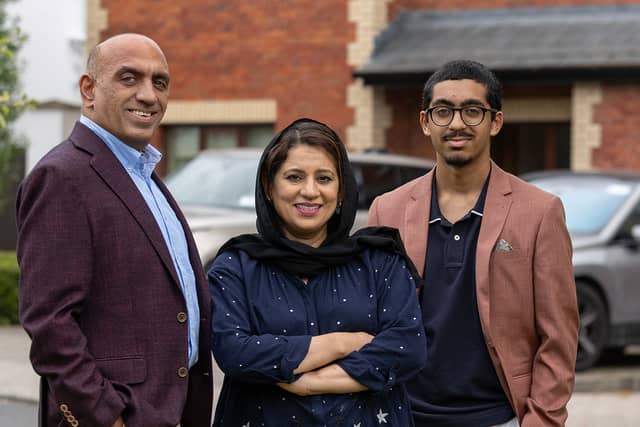

Families of Clonmel
I felt instantly welcome when I met Athar and Lubna Sheikh at their home. Athar guides me into their living room, as Lubna places another dish on a table already laden with a wonderful selection of food. The sun streams into this beautiful room, the windows reveal a lovely garden full of lavender.
As we sit down, Athar tells me that he and Lubna Sheikh are originally from Pakistan. I ask about what brought them to Ireland. Athar says he left Pakistan in December 1995 for Letterkenny, Donegal to work as an International medical student. At that time International Medical Students completed a two week honorary (unpaid) shadow placement in a hospital. After two weeks in Letterkenny, Athar was recommended for a position in a Dublin hospital. The shadowing system allows doctors to get to know the system and its processes.
READ MORE: An Indian wedding and a Clonmel home
He and Lubna were engaged before he came to Ireland, Lubna moved two years later. They have three children who were born in various counties in Ireland; in fact, they have lived in almost all the counties, bar Limerick. They have now been in Ireland as long as they were in Pakistan.
Athar remembers that when he arrived it was interesting to learn the significant dfferences between the Irish and Pakistani health systems. Unlike Pakistan, the Irish Health System is a service for patients’ welfare paid for by their taxes. There, a patient will call a doctor ‘Sir’, but here doctors are calling the patient Sir.
Ireland has an ethics and culture of Governance which surrounds your work. You can only do what you are trained to do. There is accountability for your decisions and actions and weekly meetings to discuss outcomes. Athar’s own high standards and value system is clearly very much aligned with the Irish system; he is a surgeon who specialises in bowel surgery.
They moved to Clonmel when Athar was advised to apply to Cashel to work with Peter Murchan so that he could realise his full potential. He had to repeat the shadowing process for three months (unpaid, but with accommodation) until a position became available. His work is clearly his passion: he derives great satisfaction from doing his job well.
Lubna laughs, she says “he could not live without his work, it's his life”. She says that shopping with Athar takes too long as he is stopped by patients wishing to thank him and catch up. Athar explains that he is part of the generation of doctors who have transitioned from open surgery to keyhole surgery.
Lubna was 24 when she moved to Ireland. She has four brothers and is the only daughter in her family. Her brothers in Pakistan all want their mother to live with them.
Her real name is Bushra. which is a very common name she says. Her brother gave her the nickname Lubna, which has stuck ever since, and she has never felt that Bushra really fits her. Lubna has completed her MA, and has also completed numerous courses such as one in interior designing, and another in computer studies.
She remembers that in 1997 there were not very many other cultures living in Ireland. She felt that fitting in could be difficult at times, particularly after the events of 9/11.
Lubna's passion is her family and her cooking. She is very active within the community and loves helping people who move here to settle in. She has a lovely way about her and an infectious warm giggle; it’s no wonder that people contact her for help. Although she has always remained at home, she tells me that she has always been involved in the local community through her children, wherever they have lived.
Their first child, Roisín, was born in Cork. When she was small, Lubna moved briefly back to Pakistan to look after Athar’s terminally-ill mother, and then Alia was born when Roisín was two. Then they had a nine-year gap before Abdul was born. He is doing his junior cert exams.
Roisin recently got married in Pakistan; she had always wanted a large Pakistani wedding. I am shown a gorgeous photo of the family in traditional dress. Roisín’s wedding lasted three days for the 400 guests, and the new bride regards herself as Irish/Pakistani and her husband as Pakistani/Pakistani. The couple are both doctors with Roisín is currently working in the acute medical unit in Basildon in the UK.
When the children were young, there were challenges in school from being from another culture. Alia played hockey for a while at school in which she experienced some of these challenges. She ended up giving up on hockey, which the family say may have been for the best. Alia won the Boston Scientific Award in 6th Year which earned her six months of experience there. Her photo was in The Nationalist when she achieved 625 points in her Leaving Cert; she went on to do medicine in Queens University, Belfast. Before departing for Queens, Alia took a year out in which she provided free grinds to Leaving Cert students. She sat the HPAT exam for medicine in which she came up a little short of what she needed. She got higher points for the UK, so went to Belfast. She has since graduated and is now a doctor in Manchester.
Abdul was born in Galway. A few years ago, Athar asked him “What will you be?” He replied, “I would love to be a footballer, but will probably end up being a doctor”.
He attended St.Peter & Paul’s CBS. where in 6th Class he won the Academic Award crowning him the Academic Student of his class for the 8 years of Primary School.. He feels that it’s cool that all doctors are part of a network of people who know each other.
Abdul can speak Urdu which allows him to connect to his grandparents and cousins, although he says his accent is not as good as his sister’s. He finds here that some other Pakistani families have not taught Urdu to their children. He loves the connection of being able to speak to their extended family when they visit Pakistan. Athar tells me that Lubna is quite famous within the hospital for her hospitality, food and support.
Abdul says that she now bypasses his father to go to Abdul's sisters but she also puts the query in the family Whatsapp group for someone to solve. They all discuss the problem to come up with a solution. Their new son-in-law is in Ear, Nose and Throat, so he’s a great addition to the group. Athar laughs, and says he is often contacted by new people from the hospital for Lubna’s help with available accommodation and getting a recommendation, although this is less so now as houses are scarce.
Soon, they are visiting family in Mecca for a few days. Then they will go to their house in Pakistan where Lubna's mother will join them. Roisín was married from this house. While there, they will be kept busy with family visitors.
As we are finishing, Kitkat, their cat, comes in to stake a claim on the sofa. She is an integral member of their family now. Kitkat adopted them a few years ago, and has stayed ever since.
I know how she feels: this is a family that makes you feel at home in their presence. I leave with enough cake and food for a few days. It is no wonder that they are a hub of community activity and support.
FAMILIES OF CLONMEL
Clonmel Applefest, in conjunction with The Nationalist, is delighted to share the ten stories that comprise its ‘Families of Clonmel’ book launched during last September’s Applefest.
Ten Families originally from or who have lived in Clonmel for at least 10 years are included in the book for which nominations were sought and secured after a lengthy selection process. For each cohort, the family head was interviewed in their homes with a final photograph by John D. Kelly included with the wider multigenerational family. Families come from a wide spectrum of backgrounds, from well-established Clonmel natives to more recently arrived families. Included in the book are: The Burkes, Caseys, Dempseys, Gleesons, Hacketts, Hewitts, Mcnamaras, Molloys, Purcells, and Sheikhs. All shared what they enjoy doing together and why family is important to them.
This project would not have been possible without the participation of a vibrant cohort of locally-based committed community writers who took an interest, interviewed and wrote about the selected families under the mentorship of Sean O’Connor, an accomplished writer and editor from Nenagh. This ambitious project was made possible with a grant from the Arts Council of Ireland and additional support from Age-Friendly Tipperary and The Museum of Hidden Histories.
The festival theme in 2025 was ‘The Ties that Bind’ and these stories demonstrate love, humour and caring in a very real and meaningful way. Copies of the book can be purchased for € 12 at Hickey’s Bakery, the Narrow Space Gallery and Chou’s Cottage (including via shops’ websites).
Theresa Jones
Theresa Jones has published two collections of narrative poetry, ‘Servant of Time’ and ‘Waterfall of Intentions’. She will shortly publish her third collection. Her poems reflect her feelings on life, nature, and human nature, particularly domestic violence and its impact. She takes part in spoken word events in Tipperary including Applefest, Clonmel Junction, Culture Night, Clancy Festival. She enjoys writing people’s stories. She has been published on RTÉ Radio, Seascapes, and on KCLR IMRO Radio Awards ‘Womens Bits’, 2020. Theresa loves walking, and has two adult children, two dogs, and a horse.