The woman was conveyed to University Hospital Limerick for treatment of serious injuries. She was pronounced deceased yesterday evening.
Search


02 Apr 2026

Please allow ads as they help fund our trusted local news content.
Kindly add us to your ad blocker whitelist.
If you want further access to Ireland's best local journalism, consider contributing and/or subscribing to our free daily Newsletter .
Support our mission and join our community now.
To continue reading this article, you can subscribe for as little as €0.50 per week which will also give you access to all of our premium content and archived articles!
Alternatively, you can pay €0.50 per article, capped at €1 per day.
Thank you for supporting Ireland's best local journalism!

The demonstration over the closure of the Racket Hall Hotel last month. Photo: Darren Keegan

Roscrea does not house 85% of asylum seekers in Tipperary.
That is according to figures requested by Sinn Fein TD Martin Browne and provided to the Tipperarylive.
Based on those figures, the total allocation to Roscrea is between 21% and 55%, depending on the definition of the term asylum seeker.
As of January 30, 2024, Roscrea was accommodating 153 people under the Temporary Protection Directive for Ukrainian refugees.
This is just nine and a half percent of Ukrainian refugees in the county.
Roscrea accommodates many more International Protection Applicants, with 321 people staying in the town.
But this only comes to 55% of the county’s IPA residents. Asylum seekers and beneficiaries of the Temporary Protection
Directive are not the same.
Asylum seekers have applied to be refugees and are more commonly known as IPAs or International Protection Applicants.
Adding those together, Roscrea was accommodating 21% of all asylum seekers and Ukrainian refugees in the county in January.
The figures were released to the deputy by the Minister for Children, Equality, Disability, Integration and Youth Roderic O’Gorman, as part of a parliamentary question submitted on January 30 by Martin Browne, which is available to the public from oireachtas.ie.
CAPTION: Parliamentary Question submitted by TD Martin Browne to the Minister for Children, Equality, Disability, Integration and Youth Roderic O’Gorman on January 30, 2024. Available on oireachtas.ie.
During the height of the Racket Hall protests in January, many protesters claimed that Roscrea was accommodating 85% of all asylum seekers in the county.
Some posters on social media reduced that to 80%. The Tipperary Star was unable to find the source of the claim, and it was unclear if protesters understood the difference between the two schemes.
Several social media posts, videos online and a Gofundme page suggested the term asylum seeker is not well understood.
However, the Tipperarylive can confirm that based on the figures released by the Minister, the claim is false.
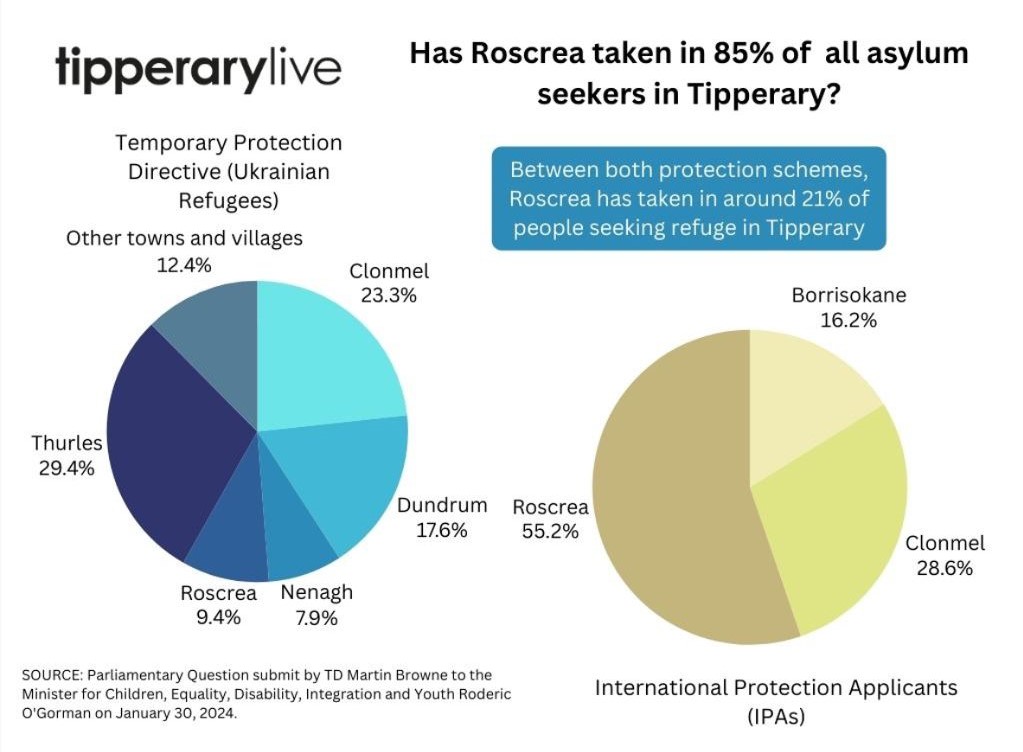
The figures given to the Tipperarylive show that between the two schemes 2,263 people are being accommodated in Tipperary.
Of those 1,682 were under the Temporary Protection Directive, while 581 were International Protection Applicants.
Roscrea was the town with the highest proportion of IPAS residents, with 321, followed by Clonmel at 166 and Borrisokane sheltering 94.
Thurles had the highest number of Ukrainian refugees at 479 people protected in the town. Clonmel followed with 379 and Dundrum with 286.
A further 202 people are being accommodated under the directive in Ballyporeen, Cahir, Carrick-on-Suir, Cashel, Clogeen, Knockanrawley, Killenaule, Templemore, Tipperary Town and Fethard.
In his answer to Deputy Browne, Minister O’Gorman said that these figures can change due to accommodation availability and contract changes.
Maybe.
According to the Local Area Plan for Roscrea, the council plan to increase the population of Roscrea by 20% by 2031.
This is based on Census 2016 figures that show that Roscrea’s population between 2011 and 2016 only increased by 0.8%.
However, Census 2022 figures, which were not available when the plan was developed, show that between 2016 and 2022, Roscrea’s population rose by 21%. The LAP said the plan was to accommodate approximately 6,293 people in Roscrea.
As of 2022, the population of Roscrea stood at 6,606. It should be noted that asylum seekers are transient.
They may be accommodated in a centre while their application is processed, but that does not mean they will stay in the town if they are granted leave to remain.
And, of course, not all applications are granted.
But what about services?
According to the Local Area Plan, 2,349 or 40% of the population of Roscrea live in either a disadvantaged or very disadvantaged area.
So, Roscrea certainly has issues with services.
But both the Local Area Plan and the Town First Plan for Roscrea aim to improve infrastructure, housing and services in
Roscrea between now and 2030.
It is important to note that these plans are not set in stone. Over the lifespan of the LAP, groups will be formed and other
projects developed. The plan is the beginning of a process, not the end.
All plans for the county, including those for Roscrea are available to the public from the Tipperary County Council website.
It was not clear from the slogans and speeches at last month’s protests whether protesters considered asylum seekers and refugees as the same group.
However, initial reports on January 11 when the protests began suggested that those who were to be housed at the Racket Hall were Ukrainian.
Therefore, one might assume that there was at least some conflation of the two groups.
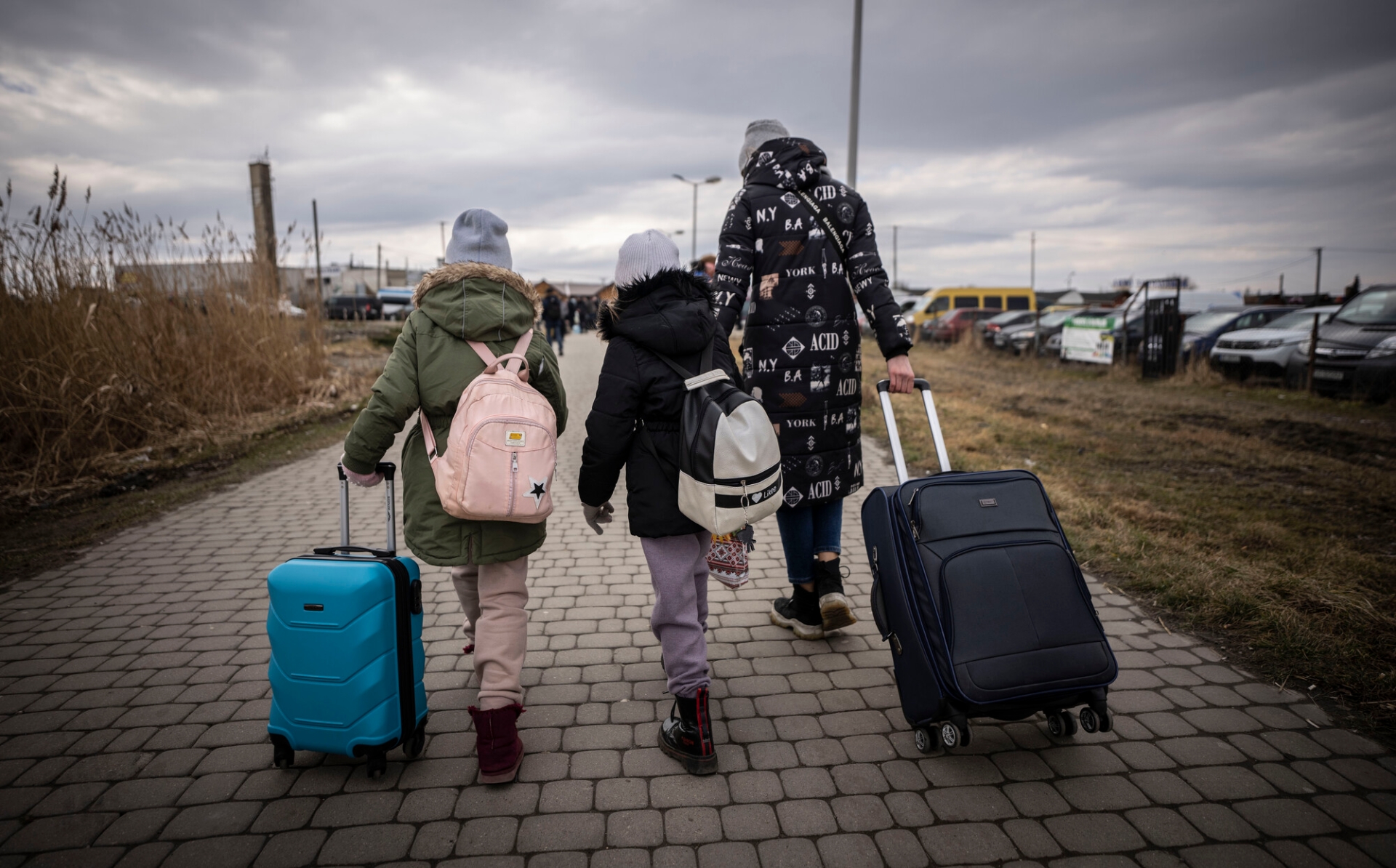
An asylum seeker is somebody who has applied to become a refugee. In Ireland asylum seekers are sometimes referred to as International Protection Applicants or IPAs.
According to Amnesty International, an asylum seeker has left their country because it is not safe there for them to remain at home.
They may be at serious risk of persecution or their life or human rights are under threat.
Amnesty International also notes that sometimes asylum seeker and migrant are used interchangeably.
However, they say migration is different because a migrant might choose to leave their country for a variety of reasons, including safety but also work or education.
In Ireland an application for asylum is processed through the International Protection Office. Under international law, anyone has the right to apply for asylum. Once their claim is processed, they may receive refugee status.
They might also be granted subsidiary protection in the case of something like war, or they may be allowed to remain in the country on humanitarian grounds.
Otherwise they are refused and sent back to their country of origin.
This can take some time and in the meantime, the state will provide them with food and shelter and a very small allowance.
Asylum seekers are initially allowed to work. In order to take up employment, they must get permission.
But, according to Citizens Information, they can only do that if their claim has not been processed within five months.
Beneficiaries of Temporary Protection or BOTPs can claim refugee status on arrival.
According to Citizens Information the Temporary Protection scheme is a consequence of the EU’s Temporary Protection Directive.
The Temporary Protection Directive is a procedure to deal with a sudden influx of people seeking refuge outside of their countries.
It has to be triggered by the EU Commission. That has only happened once, in March 2022, in response to the outbreak of war in Ukraine.
This means that people from Ukraine can come to Ireland and other EU states as refugees without having to make an individual asylum claim. They can stay in Ireland for a minimum period of one year and maximum of three.
Beneficiaries of Temporary Protection can work in Ireland, claim benefits and avail of the health and social services.

Subscribe or register today to discover more from DonegalLive.ie
Buy the e-paper of the Donegal Democrat, Donegal People's Press, Donegal Post and Inish Times here for instant access to Donegal's premier news titles.
Keep up with the latest news from Donegal with our daily newsletter featuring the most important stories of the day delivered to your inbox every evening at 5pm.

This publication supports the work of the Press Council of Ireland and Office of the Press Ombudsman, and our staff operate within the Code of Practice of the Press Council. You can obtain a copy of the Code, or contact the Council, at www.presscouncil.ie, Lo-call 1800 208 080 or email: info@presscouncil.ie.