

The Nationalist newspaper says 'Farewell to Queen Street' - new era begins
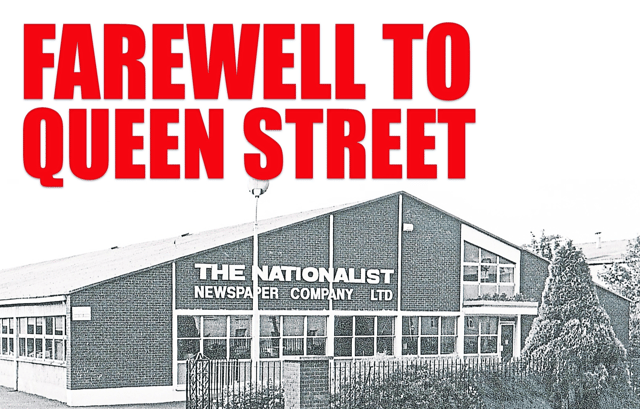

This week marks another milestone in the long and distinguished 132- year history of The Nationalist newspaper. The edition you are now reading will be the last of approximately 2,500 weekly editions compiled on Queen Street, Clonmel over the last half century or so. Soon we will move to a new premises on Gladstone Street.
In 1974, The Nationalist moved from Market Street to what were then purpose-built newspaper offices on the site of the former Fever Hospital. It was the paper’s third home having originally operated on Parnell Street in what would later become Willie Corbett’s Printers and later again Fieldmaster. Our imminent move to Gladstone Street, just two doors down from Easons Bookstore, will be the paper’s fourth home since its inception in 1890.
It is with mixed emotions that the present staff say goodbye, especially those of us who have been here for longer than we care to remember. However, changes in technology in general, and particularly in this industry, mean newspaper offices today no longer require the vast office space they once demanded.
It is impossible in a few paragraphs to try and paint a picture of what newspapers were like when I first joined The Nationalist as an apprentice compositor in 1978. Quite simply it was a different world back then, a disparate industrial era, mechanical rather than technological. The place then was a cacophony of noise and it simply had to be in order to produce a newspaper.
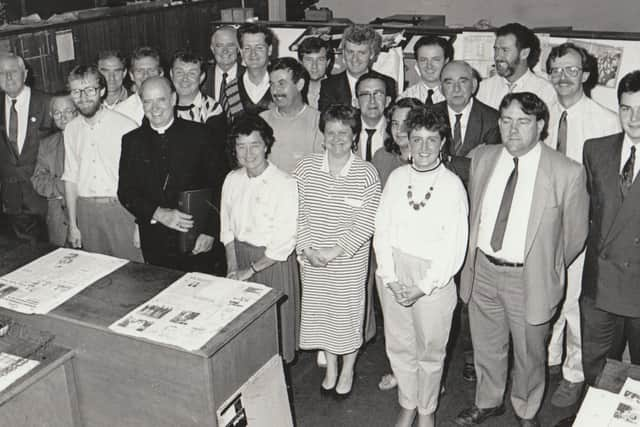
Staff members of The Nationalist gather around for a photo with the Archbishop of Cashel & Emly, Der Dermot Clifford, when he visited the offices in 1987.
In this very building, manual typewriters clattered in sync in a smoke-filled newsroom, beginning the multi-staged process. In the print works a column of Linotype machines and their operators noisily cranked out lines of hot metal type; and later again compositors skilfully composed newspaper pages “at the stone” working with metal type that was both upside down and back to front.
And, finally, when all the pages were complete they were wheeled out to the print room and “put to bed”, when loaded onto a giant rotary printing press which wouldn’t look out of place in a Harry Potter movie today.
Then at the end of the process, in an almost sleep-inducing hum, the Cossar chugged away for hours until the 16,000-plus papers were printed. Alas, that era is all long gone, now no more.
The Cossar Press, all 6,000 or so individual parts that it comprised, had been transported to Queen Street in 1974. It was painstakingly disassembled by engineers on Market Street, loaded and then transported up the town via Gladstone Street, past Ss Peter & Paul’s Church and onto Queen Street where it was precisely reassembled once again. The task was successfully completed over a few weeks, the “Old Lady” then ready to resume once more. On its snail-paced and cumbersome half-mile journey through the streets of Clonmel it would have passed the site of our soon-to-be new premises; perhaps the colossus of a printing press might have known even then its days were numbered.
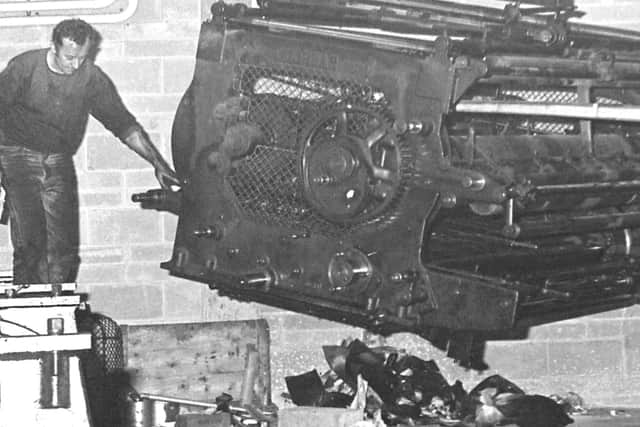
A section of the old Cossar Press is removed to begin its long journey from Clonmel to Cairo, Egypt in the early 1980s.
Within a few years, as a result of technological advances, the Cossar would be moving once again, this time slightly further afield, to Cairo, Egypt, and its new home under the shadows of the Pyramids. Sometimes, in the deathly quietness of the old printroom, in the space it once occupied, I would reimagine that press rolling and, like a long-forgotten school friend, wonder whatever became of “her” in the end. Perhaps some things are better left unknown.
A TERRIBLE BEAUTY IS BORN
In 1979 the old hot metal printing process finally surrendered to the advancement of the electronic computer and with it began rapid change. And in those famous words of Yeats’ Easter 1916, all changed, changed utterly: a terrible beauty is born. Indeed.
The new lithographic press installed, which could now print 20,000 copies in an hour, came at the end of a make-up process that was no longer mechanically based. By the early 1990s newspapers were consolidating their operations and expensive presses were the first things to capitulate. The last edition of The Nationalist was printed in Clonmel almost 30 years ago in September 1992 and since then we’ve been printed in Kilkenny, Limerick, Meath and now Northern Ireland.
But newspapers weren’t the only ones susceptible to change over the years as evidenced when browsing through the advertisements of the very first issue printed on Queen Street 48 years ago. The list of now no-longer trading businesses is extensive, including then household names such as Five-Star, Heatons, Sheila’s, Prendergast’s Garage, Boyd’s, Lowry’s, McCreery’s, Burke’s Bacon, and that’s just Clonmel alone. Time indeed waits for no young man or ‘Old Lady”, and that will always be the way of the world.
And so in saying goodbye to Queen Street we now look forward to the next period in our proud history. As ever, we will be continuing our service of bringing news to our readers through our weekly print edition and through our website, not alone once a week with The Nationalist but every minute of every day with tipperarylive.ie.
Maybe the Queen Street reign is dead, but long live the King!