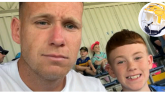
Zack with his late father Adam Hannigan at Semple Stadium.
Search


07 Apr 2026

Please allow ads as they help fund our trusted local news content.
Kindly add us to your ad blocker whitelist.
If you want further access to Ireland's best local journalism, consider contributing and/or subscribing to our free daily Newsletter .
Support our mission and join our community now.
To continue reading this article, you can subscribe for as little as €0.50 per week which will also give you access to all of our premium content and archived articles!
Alternatively, you can pay €0.50 per article, capped at €1 per day.
Thank you for supporting Ireland's best local journalism!

The Bergin family pictured at the grave on the first anniversary

On April 21, 1921, a telegram was delivered to the Bergin residence at Silver Street in Nenagh. Cathy Bergin who was five years old at the time, along with her brother James, took the message to their father, whom they recalled as working somewhere in a field nearby at the time.
To the end of her days, Cathy would recall how, on opening the telegram, her father Michael Bergin cried uncontrollably.
She could not believe how a big, strong man – her father - could cry so much. That blunt and brief telegram was from the military authorities in County Roscommon, informing him that the body of his young son John was available for collection from the military barracks in Castlerea.
His twenty-one year old son, John, along with another young Roscommon IRA man, Stephen McDermott, was fatally wounded in dubious circumstances in an encounter with British military in woodlands at Loughglynn on April 19,1921.
Michael Bergin immediately set about obtaining the services of a local undertaker in Nenagh.
The level of intimidation and fear of Crown Forces’ retribution that prevailed in the Nenagh area in April1921 was such however that neither of the town’s undertakers were willing to travel to Roscommon. Cooney undertakers did lend their hearse, and he made the long and lonely journey from Silver Street to Castlerea to retrieve the remains of his son.
A ballad, composed to commemorate the tragic event in which the two young men were killed - “The Woodlands of Loughglynn” - ascribes Seán Bergin as a Tipperary man.
Limerick folk, with good reason, might dispute this contention, as Bergin was born at Buffanoke, Cappamore on September 20, 1900. His parents were Kilkenny native Michael Bergin and Limerick woman Catherine Ryan.
Michael Bergin’s family was involved in the timber industry, but he moved his own family to Nenagh in the early 1900’s, where he set up business as a wholesaler of confectionary.
Michael Bergin was prominent in public life in the Nenagh district, as chairman of the newly-founded local branch of the IT&GWU. He was also a prominent member of Sinn Féin.
In 1918, at the height of the anti-conscription movement, he was stopped by the RIC while traveling to Borrisokane and his van was subjected to an intensive search. In the local elections of January 1920, he headed the poll to take the first seat on Nenagh UDC for Sinn Féin.
The young John (Seán) Bergin commenced an apprenticeship in the grocery trade in Dublin’s Camden Street in 1917, where he also joined the local Irish Volunteers. When violence was escalating in the city in the Autumn of 1919, he was an active volunteer in the organisation that would become the IRA.
His skills and energy in organisational matters were appreciated and, by summer of 1920, he was to be found in County Kildare, tasked with organising the IRA units in that county. From there, in the autumn of 1920, he went to County Roscommon where he was to be employed at Connolly’s sawmills in Castlerea.
With the formation of IRA Active Service Units or ‘Flying Columns’ in late 1920, Sean Bergin was appointed O/C of the south Roscommon ASU. However, about Christmas 1920, Bergin became seriously ill with pneumonia. He was nursed in a number of local houses before his condition deteriorated further and he needed hospital treatment in Castlebar.
In the days prior to his death, Seán Bergin discharged himself from hospital and made his way back to Roscommon where he found refuge in the house of Roger McDermott in the Loughglynn area. He could not have chosen a worse time to return.
In the preceding weeks, that area of south Roscommon was the theatre of a number of controversial killings. On the evening of April 18, 1921, a private Ernest Weldon of the local British army contingent was shot dead on the streets of Castlerea.
On that same evening, three other members of the IRA’s South Roscommon Flying Column, Stephen McDermott, Toby Scally and Joe Satchwell joined their O/C in Roger McDermott’s house, with the intention of resting there for the night.
Early on that Sunday morning, Roger McDermott left his house to bring in his few cows for milking. He was taken aback when he spotted British military personnel nearby, and he rushed back to the house to warn the four IRA men.
The men grabbed their weapons and such was their hurry in leaving that none of the four had time to put on their boots or even to take them with them.
The gunfire started as they ran to escape from the house, and Toby Scally received a bullet wound to the leg, causing him to fall into a drain where he remained hidden and which facilitated him making his escape later.
A running battle commenced until the three rebels made it as far as a clay bank, from where they started to fire at the troops.
But they were in a hopeless position, encircled and taking fire from several directions. Soon, Joseph Satchwell was wounded in the hand and when their limited supply of ammunition was exhausted, the three men were forced to surrender.
The three prisoners were then marched back to McDermott’s house. A soldier, Private Dovey, who was also wounded in the fire-fight, was also brought into the house.
It is reported that Dovey, believing that he was going to die from his wound, screamed for his comrades to exact retribution on the men who shot him. The wounded Satchwell was separated from his comrades at this stage and Bergin and McDermott were then marched from the house, at gunpoint, through the woodlands and on towards a waiting lorry that would take the captives to Castlerea.
However, they had not long left the house when a burst of gunfire was heard. The two prisoners fell, fatally wounded.
Michael Bergin succeeded in making the long and lonely journey to Castlerea, claimed his son’s remains and returned him to Nenagh.
As High Mass was celebrated in the town’s Church of the Holy Rosary, the church grounds were surrounded by military and police. At the conclusion of the Mass, only the immediate family were allowed to exit the church and to go out the Dublin Road to Lisbunny graveyard.
Seán Bergin was laid to rest, again surrounded by a large presence of Crown forces to prevent any paramilitary display such as the firing of volleys of shots over his grave.
According to family lore, as the coffin was being carried through the graveyard gate, an army officer told a family member that, “if any shots are fired in there, the next shots fired will be for you”.
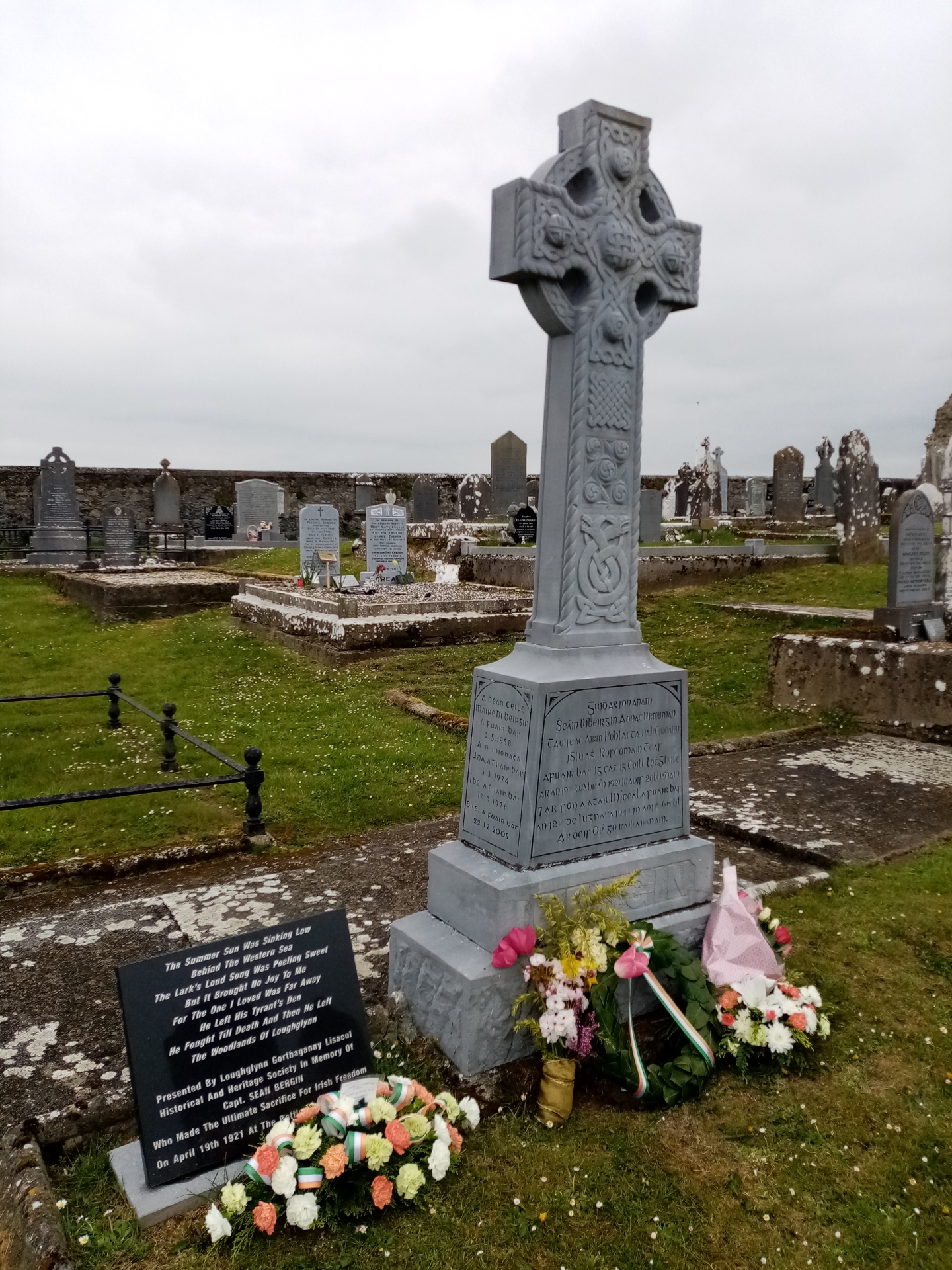
Sean Bergin’s grave in Lisbonny graveyard in Nenagh
Truth and Myth
As to establishing the reality of what actually happened on that fateful morning in Loughglynn’s woodlands, we can only patch together a picture based on the limited number of accounts available.
Although it was a contemporary account, little credence can be given to the testimony of the young army officer, Lieutenant MacKay, who was in charge of the army’s operation that morning. He presented his report to the Court of Military Inquiry that was held into the mens deaths in lieu of an inquest.
In his account, the two IRA men were fatally wounded in the course of the initial running battle between the rebels and his troops.
However, he concluded his statement by saying that, prior to their deaths, both Bergin and McDermott confessed to their involvement in the “murder” of a number of people who were killed in the Castlerea area in the weeks just prior to their deaths.
This assertion can be discounted as, for some time, Bergin was confined to Castlebar hospital because of the state of his health.
Nor is it credible that Bergin or McDermott would have used the language that MacKay, claiming to quote verbatim, especially the use of the word “murder” in relation to their IRA activities against Crown Forces.
Another account given to the Bureau of Military History in the 1950’s by Andrew Keaveney, IRA Intelligence Officer with the Loughglynn IRA Company, spoke about the men being subjected to a drumhead courtmartial and summary execution. Other accounts suggest the men were subjected to torture by being battered on the feet by rifle butts prior to being shot.
The evidence of Dr O’Donohoe, as presented to the contemporary inquiry, would emphatically discount the notion of formal execution. The wounds sustained by Bergin were to the head and spine and inflicted from behind, while McDermott was shot in the side.
An ‘execution’ would demand the presence of frontal wounds, none of which existed.
The marks that Dr O’Donohoe noted on the men’s feet can be explained by them hurriedly leaving the safe house in their bare feet and running through the scrub and undergrowth in the woodland. Dr O’Donohoe made no allusion to broken bones or bayonet wounds to the feet of the men.
The doctor’s deposition before the Inquiry can be taken as reliable, as doctors’ accounts generally were in such circumstances.
Another story that exists is that a dance/ céilí was held in the house of Roger McDermott on the night prior to the fateful incident and that Bergin sang ‘Slieve na mBan’ at this occasion. This idea can be discounted too as, while it is most unlikely that four of the most wanted men in county Roscommon would engage in any activity that would attract unwanted attention to them, it would be unimaginable that they would then stay in the dance house.
There is, however, one element of MacKay’s testimony that cannot be dismissed as being fabricated. In that testimony he states that he undertook the search of the woodland on foot of “information received that rebels were hiding out in the area”.
It is now believed that this information came from an IRA Brigade intelligence officer who was regularly providing information to the Crown Forces. That same man was fortunate to find his way to distant America before the Roscommon IRA managed to uncover his activities and exact their retribution on him.
So do we know what really happened on that Sunday morning in the Woodlands of Loughglynn? It seems certain that the finding of the Military Court of Inquiry that the men died as a result of gunshot wounds, lawfully inflicted by the Crown Forces in the exchange of gunfire, can be dismissed out of hand.
Joe Satchwell later stated that when his two comrades were taken from Roger McDermott’s house, neither was wounded.
Also, wounds described by Dr O’Donohue would rule out the possibility of the men being marched from their point of capture, first to McDermott’s house and from there to the place where both fell.
Instead, the most likely scenario is that the soldiers escorting the prisoners were in a state of high tension, with the screams of their wounded comrade demanding retribution fresh in their ears.
Shots were discharged by either nervous or malevolent soldiers, striking Bergin in the back. McDermott, who was marching in front, possibly turned in response to the sudden gunfire, and a bullet hit him in the side.
If this were the case, it would cast questions over the general discipline of his soldiers, leaving Lieutenant MacKay with some serious explaining to do to his superiors.
There were good reasons for the Lieutenant to create a narrative based on the gun-fight which had taken place and which was favourable to himself and his men.
The uniformity of the statements they tendered to the inquiry would seem to support this as the most credible hypothesis – it was after all, just a variation on the regular verdict of prisoners being lawfully shot by Crown Forces when they ‘tried to escape’.
The case of Jack Moran
A peripheral casualty of the Loughglynn affair was one Jack Moran, a native of Coolbawn in Tipperary. At the time of the woodland shootings, and the bloody events leading up to it, Moran was serving as an RIC sergeant in Castlerea.
Although there was no basis for it, word filtered back to Tipperary that the Coolbawn man had played a central role in identifying Bergin to the army authorities. Word was conveyed to his family that, if he was to return to Tipperary, his life would stand danger. On disbandment of the RIC in 1922, Jack Moran emigrated to England.
Stories were told about later generations of IRA men surveying the funerals of Moran’s parents in the hope that the former policeman would attend and they would get a chance to shoot him. Like many stories of this nature from that time, perhaps a degree of exaggeration or embellishment was employed.
One fact that cannot be disputed however, is that Jack Moran remained in England until his death in 1964, never having returned to Ireland, Tipperary or his native Coolbawn.
A year after he was killed, with the guns now temporarily silent as a result of the Truce and Treaty, a first anniversary Mass was celebrated in Nenagh to remember Seán Bergin. In a sign of what was soon to erupt, not one but two commemorative events were held in his honour in Lisbonney graveyard. The first, earlier in the day, was organised by the IT&GWU and was attended by the wider Bergin family. The second, held later in the afternoon was organised and attended by people who were in favour of the proposed treaty.
At the height of the conflict, Michael Bergin painted his shop front green, with his name scripted above the door in Irish in white and gold lettering.
Painting his premises in the Sinn Féin colours was, despite vicious intimidation and death threats from the Crown Forces who burned several premises in Nenagh owned by Sinn Féin councillors, a courageous show of defiance by Bergin.
He refused to comply with the orders to remove the offending colours and sign and his shop front remained part of the renamed Connolly streetscape for generations. The shop front has changed in recent years in the course of renovation but, the Bergin name has been preserved in a stone plaque to the front of the building.
Today, the gate giving access to the site in the Woodlands of Loughglynn where the monument marking the spot where Seán Bergin and Stephen McDermott were shot bears a big “No Trespassing” sign.
Perhaps it is an ironic comment on the words of the “Woodlands of Loughglynn” ballad below:
“These were the words our brave boys said as they died for Ireland’s cause,
To free our land from Black and Tans and cruel English laws”.

Subscribe or register today to discover more from DonegalLive.ie
Buy the e-paper of the Donegal Democrat, Donegal People's Press, Donegal Post and Inish Times here for instant access to Donegal's premier news titles.
Keep up with the latest news from Donegal with our daily newsletter featuring the most important stories of the day delivered to your inbox every evening at 5pm.

This publication supports the work of the Press Council of Ireland and Office of the Press Ombudsman, and our staff operate within the Code of Practice of the Press Council. You can obtain a copy of the Code, or contact the Council, at www.presscouncil.ie, Lo-call 1800 208 080 or email: info@presscouncil.ie.