

Tipperary mum relives serious blood clot scare during pregnancy
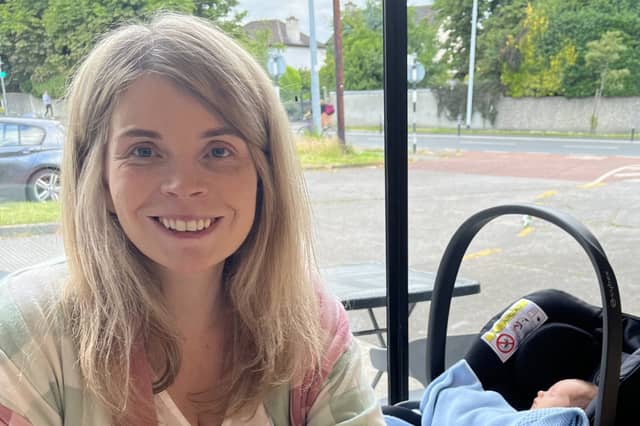

When Alma de Bruijn was just 35 years old and 10 weeks pregnant with her son, Zander, she was diagnosed with Deep Vein Thrombosis, a condition that occurs when blood clots form in deep veins, usually in the leg or arm.
A Tipperary mum has relived her experience of urgent surgery to deal with a serious blood clot ten weeks into her pregnancy.
In 2021, Alma de Bruijn, who is originally from Clonmel, was 35 years old when she started to experience lower back and leg pain.
Over 48 hours, the pain intensified, her right leg developed patches of discolouration, her right foot was very cold and she struggled to walk.
She was initially diagnosed with sciatica and was recommended exercise, massage and paracetamol.
Alma had made a physiotherapy appointment but decided instead to ring her GP, as the pain hadn’t improved.
“My right calf was 7cm bigger than the left calf at this point and my GP referred me to the Holles Street emergency department with a suspected clot,” said Alma, who lives in Clonskeagh in Dublin.
Alma was not a smoker, had a healthy BMI and no family history of clots.
“I did not meet some of the typical markers of someone at risk of clots,” she explained.
“However, I also did not know that I was at a higher risk of developing a clot due to pregnancy.”
She said her biggest concern was her baby and a scan at Holles Street confirmed that all was well with her pregnancy.
The medical team were concerned that she had a clot and administered an injection of blood thinners before transferring her to A&E in St Vincent’s Hospital.
She was diagnosed with significant deep vein thrombosis (DVT), which had travelled from her calf into her vena cava, one of the body's largest veins.
DVT occurs when blood clots form in deep veins, usually in the leg or arm and symptoms may include swelling of one leg or arm, pain in one leg or arm, warmth or redness in one leg or arm.
Sometimes there are no symptoms and DVT is only diagnosed if a complication occurs.
Alma and her husband consulted with the vascular and haematology teams, her obstetrician and the consultant in the Mater Hospital who specialised in mechanical thrombectomies.
“While there were risks associated with the mechanical thrombectomy, it would not risk the pregnancy, which was the most important thing to us.”
One week after diagnosis, she underwent a mechanical thrombectomy to remove the clot.
It was successful and a large percentage of the clot was removed but the weeks following the procedure proved challenging.
It took Alma a long time to walk, even short distances, and the twice daily blood thinner injections, administered by her husband, as well as wearing a compression stocking were an adjustment.
Almost five years on, Alma is healthy, as is her four-year-old son, Zander.
“Around 5,000 people in Ireland develop a venous thromboembolism - a blood clot in a vein - each year,” said Chair of Irish Heart Foundation Council on Thrombosis and Advanced Nurse Practitioner, Emily Bury.
“Know your risk - most blood clots occur in people with known risk factors.
“The risk is highest in the 90 days after a hospital stay, particularly for people who have had surgery, major injury, cancer or prolonged immobility.
“This year's World Thrombosis Day campaign highlights the importance of women's health and blood clot awareness, recognising that risks can increase during pregnancy, after childbirth and with oral oestrogen (hormone) treatments.
“Greater awareness can lead to earlier diagnosis and better outcomes.”
For more information and supports on thrombosis, visit irishheart.ie.