PICTURE: Sportsfocus
Search


05 Apr 2026

Please allow ads as they help fund our trusted local news content.
Kindly add us to your ad blocker whitelist.
If you want further access to Ireland's best local journalism, consider contributing and/or subscribing to our free daily Newsletter .
Support our mission and join our community now.
To continue reading this article, you can subscribe for as little as €0.50 per week which will also give you access to all of our premium content and archived articles!
Alternatively, you can pay €0.50 per article, capped at €1 per day.
Thank you for supporting Ireland's best local journalism!

Omni Medique is a specialist regenerative hair and scalp clinic providing non-surgical hair restoration and scalp treatment services to men and women suffering from hair loss.
At Omni Medique, the team understand that hair loss is a symptom of a cause. Rather than just treating the symptom (hair loss), they instead first investigate the cause as there are many reasons for hair loss.
Once the cause has been established, a personalised hair restoration program is then arranged for patients. The investigation may include blood tests, dermoscopic scalp analysis, nutritional mapping, medication review and lifestyle assessment.
Omni Medique was founded by Charlotte Matabaro, a Clinical Aesthetician who discovered a passion for hair restoration while caring for her terminally ill aunt who sadly lost her hair due to chemotherapy. Witnessing the impact of her aunt’s sudden hair loss uncovered a hidden passion and desire to help people suffering from similar conditions and ultimately led to Charlotte’s career path of becoming a Trichologist.
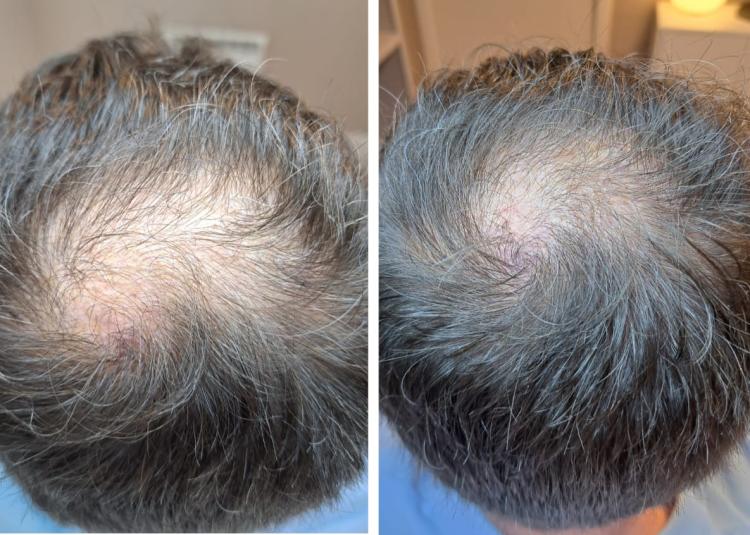
Down below is one patient, who has experienced extraordinary hair growth just six weeks into his treatment.
At Omni Medique, a 360 approach is adopted when it comes to diagnosing and treating patients.
The team considers:
* Internal factors
* External factors
* Genetic predisposition
* Environment
* Hormones
* Stress
* Nutritional deficiencies
* Underlying medical conditions
* Auto-immune factors
* Certain medications
* Physical/chemical factors
Omni Medique understand just how important the appearance of hair is and how upsetting it can be to notice hair thinning at any age.
“In recent years there have been so many clinical advancements in the field of trichology that have been proven to restore hair, patients now have many options to choose from,” Charlotte explains.
“Normally after a patient has had their initial consultation with me, we schedule a follow up appointment where they can begin their treatment
“After their first treatment is complete, I ask them to come back after 6 weeks for a review. As hair grows at a rate of 1 cm per month, we generally see progress at the 6-week mark.”
Charlotte continued: “For me, comparing the before and after pictures for the patients at the 6-week mark is the most exciting part of my work. Seeing their face light up when they see new hair growing is so magical, each and every time.” She adds “It really is miraculous.”
The Trichologist has seen an increase in patients who have had hair transplants overseas and initially are happy with their results, but said, “After about 12 months they begin to see hair shedding again and are often confused by this as these procedures are often sold as a ‘one and done’ type package deal.”
While hair transplants can be successful, the underlying cause of the original hair loss remains as this was never addressed in the first place. Regular PRP treatments are required to maintain a hair transplant to ensure that the newly transplanted follicles are adequately nourished.
Charlotte notes that it is important that people consider this before they opt for a hair transplant, typically a PRP is administered every 3 months to help to maintain the newly transplanted follicles.
The business pride themselves on their open and honest approach with patients at each and every consultation.
“After a thorough consultation, I always let patients know what I believe the prognosis is. There is no point offering false hope, if I feel that I am unable to help them achieve their goal. Open honest communication is vital when dealing with such a distressing issue. I find patients really appreciate my black and white, logical approach. The most important thing is the diagnosis. Once I have made the diagnosis, we can then begin offering effective treatment," Charlotte said.
She added: “There are so many advertisements on social media offering people false hope. If you buy this serum, shampoo or conditioner etc. your hair will grow back. These claims are baseless and lacking in any clinical trials or credible research.
“The truth is, no serum, shampoo or conditioner will grow your hair back if you are suffering from a hormonal imbalance, a form of alopecia or a nutrient deficiency. These conditions must first be clinically diagnosed before a suitable treatment can be offered.” Charlotte finds these types of misleading advertisements frustrating, saying it is” Offering false hope to people who are going through something as distressing as hair loss is completely unethical and upsetting to witness.”
-1747993405664.jpg)
The clinically proven treatments that we offer may include but are not limited to:
* PRP hair restoration
* Stem cell therapy
* Microneedling
* Topical application of certain medications
* Nutrition support
* Lifestyle planning/stress management
What are the most common causes for hair loss?
Hereditary hair loss: Both men and women develop this type of hair loss, which is the most common cause of hair loss worldwide. In men, it’s called male pattern hair loss and up to 85% of men may experience this. Approximately one-third of women develop female pattern hair loss. Regardless of whether it develops in a man or women, the medical term is androgenic alopecia.
Alopecia areata: Alopecia areata is a disease that develops when the body’s immune system attacks hair follicles, causing hair loss. Individuals can lose hair anywhere on their body, including the scalp, arms and legs, some people lose their eyelashes or eyebrows.
Childbirth, illness, or other stressors: A few months after giving birth, or recovering from an illness, or having an operation, people may notice an increase of hairs in their brush or on their pillow. This can also happen after a stressful time in life, such as a divorce or death of a loved one.
Hormonal imbalance: A common cause of this imbalance is polycystic ovary syndrome (PCOS). It leads to cysts on a woman’s ovaries, along with other signs and symptoms, which can include hair loss. Stopping some types of birth control pills can cause a temporary hormonal imbalance. Thyroid disorders also account for diffuse hair shedding in women. Women who develop a hormonal imbalance can develop thinning hair (or hair loss) on their scalp.
Medication: A possible side effect of some medications is hair loss, particularly weight loss medication. If you think a medication is causing your hair loss, ask your doctor who prescribed it if hair loss is a possible side effect. It’s essential that you do not stop taking the medication before talking with your doctor. Abruptly stopping some medications can cause serious health problems.
Scalp psoriasis: Many people who have plaque psoriasis develop psoriasis on their scalp at some point. This can lead to hair loss. Is regrowth possible? Hair tends to regrow once the scalp psoriasis clears, but this takes time. By making dietary and lifestyle changes, individuals may be able to prevent hair loss.
Hair pulling: Some people pull their hair, often to relieve stress. They may be unaware that they’re pulling their hair. The medical term for this is trichotillomania
If you would like to find out more about Omni Medique and their Trichology or health services, please call: 062 88002 or email info@omnimedique.com to arrange a confidential consultation with Charlotte.
*Sponsored Content

Subscribe or register today to discover more from DonegalLive.ie
Buy the e-paper of the Donegal Democrat, Donegal People's Press, Donegal Post and Inish Times here for instant access to Donegal's premier news titles.
Keep up with the latest news from Donegal with our daily newsletter featuring the most important stories of the day delivered to your inbox every evening at 5pm.

This publication supports the work of the Press Council of Ireland and Office of the Press Ombudsman, and our staff operate within the Code of Practice of the Press Council. You can obtain a copy of the Code, or contact the Council, at www.presscouncil.ie, Lo-call 1800 208 080 or email: info@presscouncil.ie.