Search


01 Apr 2026
Search
01 Apr 2026

Please allow ads as they help fund our trusted local news content.
Kindly add us to your ad blocker whitelist.
If you want further access to Ireland's best local journalism, consider contributing and/or subscribing to our free daily Newsletter .
Support our mission and join our community now.
To continue reading this article, you can subscribe for as little as €0.50 per week which will also give you access to all of our premium content and archived articles!
Alternatively, you can pay €0.50 per article, capped at €1 per day.
Thank you for supporting Ireland's best local journalism!


Pictured above: A Costello family photo from 1920/1921. Back row, from left: Michael O’Carroll, Jim Fogarty, Thomas Costello, Edmond Cosstello, Johnny Costello, Willie Costello, Michael Costello. Middle row: Ellen O’Carroll (Costello), Sarah Costello, Katie Costello, Josie Costello. Front: Maggie Fogarty (Costello), Helena Costello (O’Brien), Katie Costello (Lewis), Mai Costello, Tommy Costello, Extreme Front: Paddy Costello Nora Costello and Babies Nellie Fogarty and Tommy Costello
One hundred years ago on July 20, 1922, Michael Costello (pictured below) of Clonaspoe, Dundrum lost his life in the Infirmary Hospital, Waterford having succumbed to wounds inflicted on him on July 18 at Ferrybank when the National Army advanced on Waterford.
He was a Free State soldier Service No. 55351 (also 192) A Coy, Kilkenny Barracks under the command of Colonel Commandant John T. Prout, a native of Dundrum.
John Prout was born in 1880 in Dundrum but emigrated to the United States and enlisted with the United States 69th Infantry Regiment. He spent some months attached to the French command and was awarded the Croix de Guerre.
After the war he returned to Ireland and joined the Irish Republican Army, serving as a Training & Intelligence Officer to the Third Tipperary Brigade, based at Galtee Castle.
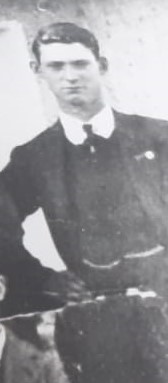
Michael Costello from Clonaspoe, Dundrum, killed in action during the Civil War in July 1922. Extensive research has been unable to obtain a Death Certificate for Michael Costello or to ascertain where he was buried
When the split came over the Anglo-Irish Treaty in 1922 he sided with the Treaty and subsequently joined the National Army, where he was given the rank of Commandant General and command of the South East, based in Kilkenny.
In 1923 he organised a number of successful operations which helped to bring the Civil War to an end. He returned to America and settled in New York. He died in 1969 and is buried in Vermont.
In all probability a friendship developed between John Prout and Michael Costello, both being from the same area, leading to a job offer as a Private in the National Army which Michael accepted so as to earn money for his parents as his father did not have consistent work due to ill-health. Michael had not been involved in the War of Independence.
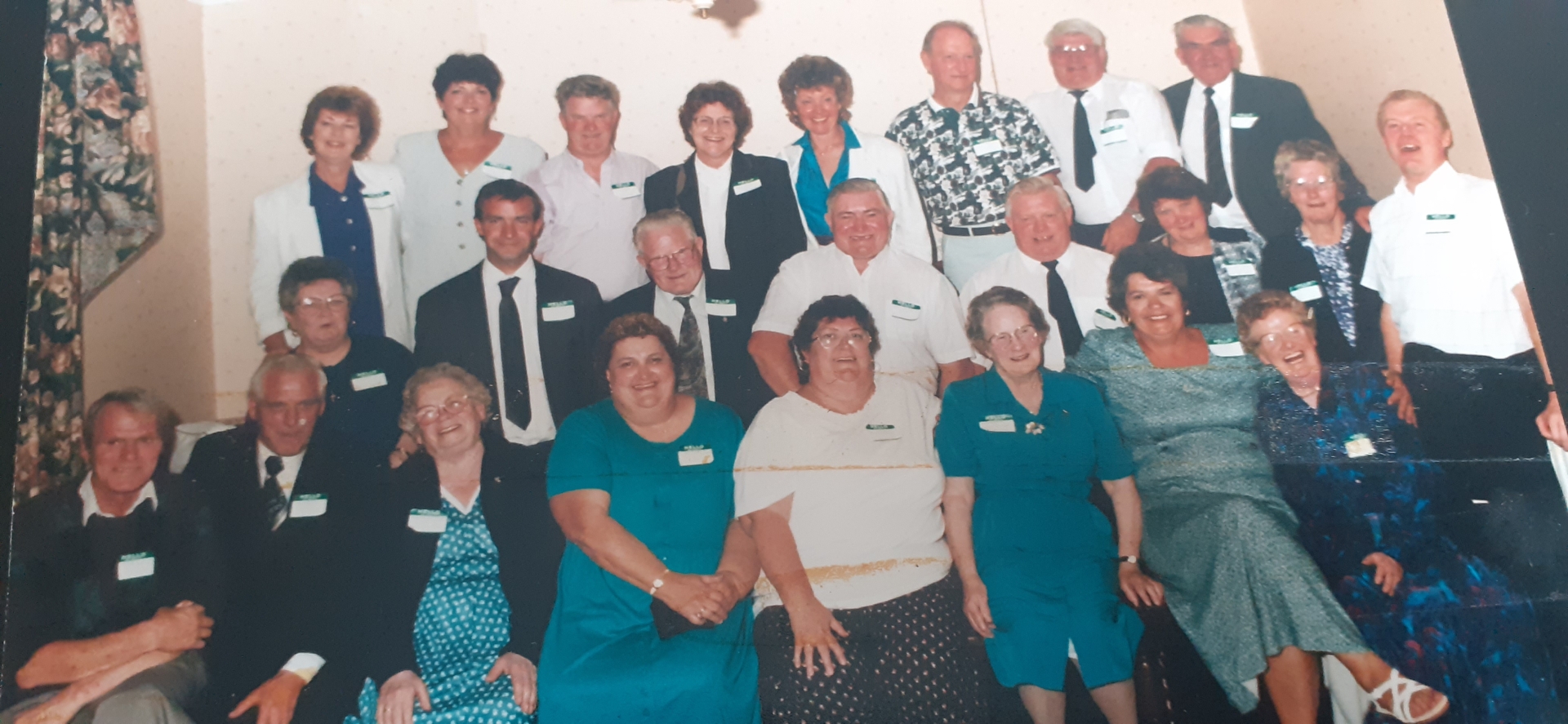
Families of the original Costello family from Tipperary and the United States, the Tipperary families being, Costellos, O’Carrolls, Delaneys and Fogartys.
The following is an excerpt taken from James Langton’s book The Forgotten Fallen-National Army soldiers who died during the Irish Civil War:
“Prior to the National Army advance on Waterford, Private Costello had taken part in several engagements at The Four Courts in Dublin and in Kilkenny. In a letter written by his father Thomas Costello which was addressed to the Secretary of the Provisional Government and dated 11/9/1922, he expressed the pride that many but not all parents had in relation to the choices their sons had made on either side of the Treaty divide when he wrote: “While I grieve his loss, I do not judge his young life for the cause to which he was devoted. Nor did I seek to prevent him when he first indicated his desire to join the National forces. Rather, I was the provider for the spirit that prompted him to it, for I felt he was compelled to take this cause by a high and sacred sense of duty”.
WOUNDED AT KILMACOW
The account in The Irish Independent of Thursday July 20, 1922 is as follows:
“An advance was made on Waterford on Tuesday by Co. Commandant Prout O.C Kilkenny. A column under his command left Kilkenny in the morning, reaching the outskirts of Waterford shortly after 6pm. Considerable road obstructions in the shape of fallen trees, demolished railway bridges and road trenches were encountered but an advance party of engineers quickly cleared these away. The column which was accompanied by an 18-pounder gun reached Kilmacow shortly before 1 o’clock and a halt of a couple of hours was made. The party split into three sections and advanced on the city from different points. They joined forces on the heights overlooking the city at Ferrybank and one section advancing across the top of the hill were fired on with Thompson guns from posts at each end of the city. Volunteer Costello, a native of Dundrum, county Tipperary, being wounded in the shoulder.”
The Tipperary Star of July 29, 1922 under “Thurles Tidings” has a very poignant account of Michael Costello’s funeral, though there are some inaccuracies as it states that he was an only son which was not the case as he had five brothers (more family details later):
“On last Saturday night the remains of Volunteer Costello, Dundrum, arrived at 10 o’clock in Thurles by motor from Waterford and were placed in the mortuary chapel of the Cathedral. Deceased who was a gallant soldier was wounded the previous Tuesday in an attack in the city of Waterford and died on Thursday. He was an only son and was barely 25 years old. On Sunday his heartbroken parents and sisters arrived in Thurles overwhelmed with grief at the great and irreparable loss they have sustained. After last Mass the remains which were accorded military honours, were removed to Dundrum for interment.
“A large body of National soldiers with arms reversed marched in single file by either side of the hearse which was preceded by Very Rev. Canon M.K. Ryan. The coffin was covered with the Tricolour and bore several beautiful wreaths. As the mournful procession wended its way towards the native place of the deceased soldier, it grew in proportions and at the graveyard was of immense size, the countryside for miles around having paid a last parting tribute to the memory of a brave man. Over the grave three volleys were fired and the Last Post sounded.”
NO DEATH CERT, NO BURIAL PLACE
After extensive research I have been unable to obtain a Death Certificate for Michael Costello or to ascertain where he was buried.
In her application to the Army Pensions Board in December 1923, Mrs Helena Costello, Michael’s mother stated that she had failed to obtain a Death Certificate for her son nor could she ascertain where his death was registered. In April 1923 an award of payment of 14 shillings per week was granted, pending the setting up of the Pensions Board. This was termed Dependents’ Allowance. His File Number was 2D33.
The Civic Guard Report states that: “The applicant is the mother to Michael Costello, deceased, the wife of a farm labourer, residing at Clonaspoe, Dundrum. As this woman’s husband is in delicate health and not fit for all kinds of labouring work, she was almost wholly dependent on her son Michael. At the present they are in poor circumstances and there is a young family of three boys and one girl to bring up. The husband can only work casually and his earnings are not consistent.
The deceased Michael Costello, prior to his joining the Army was constantly employed by farmers and his earnings averaged about £25 per year. I am informed that he gave his mother £17 a year of this money”.
On March 12, 1924 under the Army Pensions Act 1923, a gratuity of £100 was paid to Mrs Helena Costello, Clonaspoe. The previous payment of 14 shillings per week was terminated following receipt of the once-off gratuity payment. £100 was the maximum allowable under the Army Pensions Act 1923. Helena Costello was extremely disappointed with this gratuity and corresponded regularly with the Army Pensions Board right up to 1927, making further claims but to no avail.
The reason for her persistence was that they needed a new dwelling house as the one in Clonaspoe was no longer fit for purpose and her son Michael had promised to assist her in building a new one on a plot of land (three statute acres) which had been allotted to his father at Blackbridge, Dundrum upon the division of the de Montalt Estate.
As well as dealing with the irreplaceable loss of a son, Helena and Thomas had also lost out on the income from their son, an income which would have helped them build a new house, but through scrimping, saving and the help of good neighbours, they realised their dream and moved from the Bog Road to River View Cottage, Blackbridge, Dundrum in 1927.
Michael Costello’s final resting place has remained a mystery and it is by pure assumption that I consider it to be in Toem graveyard as both of his parents were subsequently buried there in 1947 and 1948 respectively. Other Costello family members continued to be buried there up to the 1960’s.
It seems that talking about Michael and the part he played in the Civil War was a taboo subject among his siblings as he was rarely spoken about by them.
Michael Costello was most definitely a Forgotten Soldier. Apart from family members not having heard of him, neither did any of the present people of Knockavilla.
Michael Costello’s background and family:
Michael Costello was born on March 15, 1897 at Clonaspoe to Thomas and Helena Costello (née O’Brien). He was their fourth child, having two older sisters, Maggie (1893) and Ellen (1896, my grandmother). He had one older brother, Edmond (1894). Nine more siblings followed, Sarah (1899), John (1900), William (1902), Katie (1904), Johanna (1905), Mai (1907), Thomas (1908), Patrick (1909) and Nora (1911). He was baptised in the Church of the Assumption, Knockavilla where one of his sponsors was John Brien. He attended Knockavilla National School. After leaving school he spent most of his time working with farmers in the locality.
The 1911 Census states his occupation as a Farm Labourer and he continued as such until he joined the Free State Army in 1922. His name does not appear on any Volunteer list during the War of Independence.

Subscribe or register today to discover more from DonegalLive.ie
Buy the e-paper of the Donegal Democrat, Donegal People's Press, Donegal Post and Inish Times here for instant access to Donegal's premier news titles.
Keep up with the latest news from Donegal with our daily newsletter featuring the most important stories of the day delivered to your inbox every evening at 5pm.

This publication supports the work of the Press Council of Ireland and Office of the Press Ombudsman, and our staff operate within the Code of Practice of the Press Council. You can obtain a copy of the Code, or contact the Council, at www.presscouncil.ie, Lo-call 1800 208 080 or email: info@presscouncil.ie.