Gardaí are appealing for witnesses following a serious road traffic collision in Sligo
Search


21 Apr 2026

Please allow ads as they help fund our trusted local news content.
Kindly add us to your ad blocker whitelist.
If you want further access to Ireland's best local journalism, consider contributing and/or subscribing to our free daily Newsletter .
Support our mission and join our community now.
To continue reading this article, you can subscribe for as little as €0.50 per week which will also give you access to all of our premium content and archived articles!
Alternatively, you can pay €0.50 per article, capped at €1 per day.
Thank you for supporting Ireland's best local journalism!

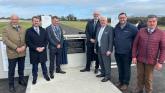
Ruairi O’Caisleain (Suircan), Dr Aoife Egan (Project Advisor), Myriam Madigan (Suircan), Malcolm Noonan TD, Rosemary Kennedy (Suircan), Paddy Kiely (Suircan) and Mike FitzGibbon (Suircan)

The Anner Hotel in Thurles on Saturday, June 10, was the setting for the launch of the Invasive Plant Species Mapping and Mitigation on the River Suir 2023 project.
The project is a citizen science venture to map the distribution of invasive plant species along the river Suir and its tributaries.
Suircan is a voluntary environmental group that operates in and around the Clonmel area, primarily concentrating on the River Suir.
In attendance were Minister of State Heritage and Electoral Reform Malcolm Noonan, members of Suircan Environmental from Clonmel, Local Authority Waters Program (LAWPRO) and members of the public.
What are invasive species?
Invasive species are animals and plants that are introduced accidentally or deliberately into a natural environment where they are not normally found, with serious negative consequences for their new environment.
They represent a major threat to native plants and animals in Europe, causing damage worth billions of Euros to the European economy every year.
A classic example is the takeover of parts of Killarney National Park (and other areas) by Rhododendron, which squeezes out other plants and has even been suggested to contribute to fire risk.
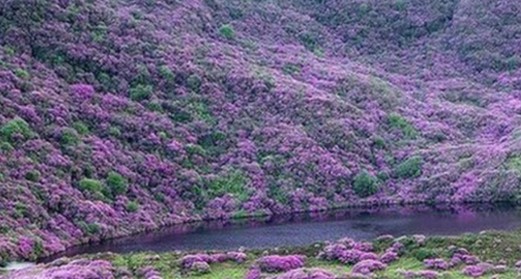
Invasive plant species Rhododendron invasion in Knockmealdown mountains.
This is now a major problem in the park and requires significant resources to manage.
Along the banks of the River Suir in Tipperary (and in many other locations) there are several other types of invasive plant species.
While they are currently not as significant an issue as Rhododendron, there is a risk of a similar takeover occurring if they are left unchecked.
Essentially, when it comes to invasive species, the sooner action is taken, the cheaper and easier they are to control.
The main invasive plant species along the banks of the River Suir are Giant Hogweed, Himalayan Balsam and Japanese Knotweed. These are our target species for this year’s project.
The Launch
The launch event discussed the progress that was made last year, including the distribution and density of the plants that were mapped in 2022.
In addition, the resulting map of invasive plants on the Suir was reviewed, which has now been uploaded to the National Biodiversity Database.
More importantly, the large areas of the Suir where there is no information were highlighted, and the need to recruit local volunteers to assist in mapping those areas was emphasised.
The Minister gave an update on government plans for the next Biodiversity Action Plan that would envisage local communities working hand in hand with professionals from state agencies such as the National Parks and Wildlife Service (NPWS) and Inland Fisheries Ireland (IFI) in not just collecting data but also having an input into the management of invasive species in their local areas and how projects such as this one will likely play a critical role in managing them going forward.
-1687346373992.jpg)
Work on this national strategy is currently ongoing but likely, will not be completed until sometime in 2024.
Feedback
Dr Fran Igoe Southern Regional coordinator for Local Authorities Water Program (LAWPRO) had the following feedback on the current project:
“This project, led by Suircan, is an important initiative for County Tipperary.
“Invasive species can spread very quickly along our watercourses, and LAWPRO commends the work by Suircan to highlight this issue head-on and for taking practical steps to control their spread.”
He continued to describe the environmental and economic importance of these plants as Giant hogweed, in particular, is of concern as it is present at a number of locations along the River Suir.
“This plant is not only of concern from an environmental perspective but can be hazardous from a human health point of view, as the sap from the plant can cause severe burns to the skin. Himalayan balsam and Japanese Knotweed can pose a risk from a water quality, amenity and a local economic perspective, if allowed to get out of control.”
This project takes an integrated catchment management approach, and according to Dr Fran Igoe:
“This is the only way to address the issue to meet long term success”.
Furthermore, experiences from other areas, such as the invasive species control work by the rural development company IRD Duhallow on the Munster Blackwater, have shown that when planned properly, community led projects like this one can provide effective control of invasive species.
This works best when coordinated with and supported by the relevant state agencies.
Also reviewed at the event was a collaboration with Trinity College Dublin, the Environmental Protection Agency and Geological
Survey Ireland on a new and innovative water sampling project.
It aims to analyse the transit time of rainfall through the river catchment area, ie how long it takes for a drop of rainwater from the time it falls, goes through fields, rocks ,aquifers and finally ends up in a stream or river.
Knowing this will allow scientists to predict how long it will take changes in human activities (e.g. microplastics, heavy metals or pesticide use) to affect water quality.
This will be achieved by analysing the samples to determine the proportion of various stable isotopes present, and this will be used to estimate the age of the water.
This is truly a unique opportunity for potential Citizen Scientists to be associated with cutting edge technology.
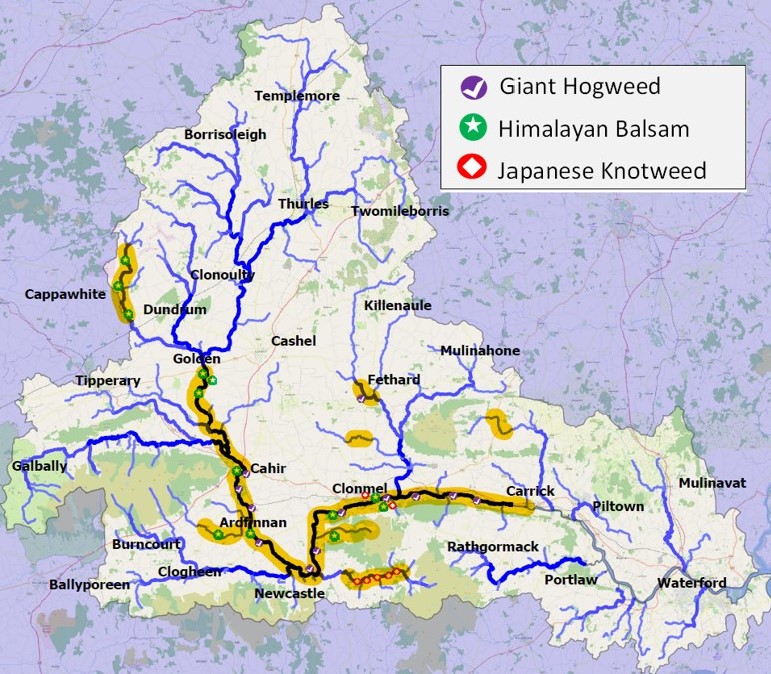
Suircan invasive map from 2022, areas that have been checked are highlighted in yellow.
Getting Involved
Interested volunteers will be trained and requested to take small samples of water from the river Suir, over a number of months.
The samples will then be collected and analysed, with results published sometime in 2024.
There will be a number of Zoom presentations held in the coming weeks for the purpose of giving more information to anyone who wishes to participate in the mapping project or the age of water project.
In addition over the coming weeks, Suircan volunteers will be holding in- person training sessions on dates and venues that will be determined by the demand and location of volunteers.
General information can be found on the River Suir Project Facebook page or the Suircan Environments Facebook page.
Expressions of interest or for further information, please contact Aoife Egan or Mike Fitzgibbon at riversuirproject@gmail.com

Subscribe or register today to discover more from DonegalLive.ie
Buy the e-paper of the Donegal Democrat, Donegal People's Press, Donegal Post and Inish Times here for instant access to Donegal's premier news titles.
Keep up with the latest news from Donegal with our daily newsletter featuring the most important stories of the day delivered to your inbox every evening at 5pm.

This publication supports the work of the Press Council of Ireland and Office of the Press Ombudsman, and our staff operate within the Code of Practice of the Press Council. You can obtain a copy of the Code, or contact the Council, at www.presscouncil.ie, Lo-call 1800 208 080 or email: info@presscouncil.ie.