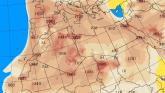
Pictured is a still of a University of Athens map shared by Carlow Weather on social media
Search


03 Mar 2026

Please allow ads as they help fund our trusted local news content.
Kindly add us to your ad blocker whitelist.
If you want further access to Ireland's best local journalism, consider contributing and/or subscribing to our free daily Newsletter .
Support our mission and join our community now.
To continue reading this article, you can subscribe for as little as €0.50 per week which will also give you access to all of our premium content and archived articles!
Alternatively, you can pay €0.50 per article, capped at €1 per day.
Thank you for supporting Ireland's best local journalism!

Pictured at launch of Tipperary Historical Journal in Source, Thurles, Danny Grace (chairperson), Liz Howard ( launched journal), Des Marnane (editor)

For thirty-five years Tipperary Historical Journal has provided a platform for some of the most interesting research being done on many aspects of the county’s history and heritage.
Nowadays, publication of such a county annual is an important declaration of a county’s sense of itself, and it’s hard to think of a county that lacks such a dedicated journal.
Certainly, neighbouring counties comply, though the Tipperary journal is among the best with respect to the variety and depth of its articles.
This year’s issue was launched recently at The Source in Thurles by Liz Howard, a woman who needs no introduction to Tipperary readers.
Reflected by the front cover illustration the featured article is a comprehensive discussion by Denis G. Marnane (who is the journal editor) about the building of labourers’ cottages in the county.
Perhaps not the most obvious topic, but travel any road in the county, and one of the most common features is the labourers’ cottage, now of course frequently disguised because changed and extended over the years but in its time a huge social and economic revolution.
Farm labourers were usually very poorly housed.
Legislation in 1883 and 1906 changed all that and provided workers and their families with new homes, initially with half acre and later with acre plots.
The rate of construction depended on the enthusiasm of local authorities, some a lot better than others.
By 1900, Tipperary (town and district) had applied for funding for 1,290 cottages whereas Roscrea had applied for 34.
During the last forty or so years of British administration in Ireland, nationally, around 48,000 cottages were built. An aspect of the story detailed in Marnane’s article is the reaction of the county’s farmers who, willingly or otherwise, supplied the sites.
A related article by Padraig Lane discusses the fortunes of farm labourers in the county during the 1880s. Several articles focus on the 1840s, the most intimate and immediate being that by Gerard Walsh from Moyglass (now living in Canada).
He discusses his personal links to the Great Famine: his father was born in 1912 at Graystown Killenaule, and as the writer notes, at that time there were 250 people living in the parish that were at least six years of age at the height of the famine in 1847.
Therefore, not long ago and far away.
Delving into family history is not at all unusual. Connecting family history to the Great Famine and its impact, is remarkable.
An essential part of the famine story is the workhouse, and John Keating describes the working of the workhouse in Clogheen during the famine period.
Built for a maximum of 500 inmates, a figure never reached before the potato crop failed; by the end of February 1848 1,144 people were being accommodated in that building and ancillary accommodation while a further 5,500 got outdoor relief .
This article obviously pays close attention to the surviving records and always of course, facts and figures relating to the Great Famine are overwhelming.
An Australian writer Richard Cashman writes about Thomas Gallogly, who was a medical doctor in Clogheen and did his best for the community and for those in the workhouse, where he was medical officer during the Great Famine and after.
A very different aspect of the famine story is explored by Gay Lowry, who tells the story of sixty-two and later twenty-five female orphans who in 1849, were dispatched from Tipperary Workhouse to Australia.
For children who lives were encompassed by the walls of the workhouse, their journey to Dublin, then a crossing to Plymouth and finally the epic voyage of over a hundred days to Port Philip near Melbourne, was outside their imaginations.
An obvious reaction to such a story is to wonder what became of these girls?
David Harris, an Australian descendant of a man who left Thurles around 1860, tells the story of his own family and how they fared at the other side of the world.
The author goes from the baptism of John Long in Thurles Cathedral in February 1842 to standing beside his grave in a desolate burial ground in the middle of nowhere in South Australia.
Given the pressures and pains of the 1840s in Ireland one answer was violence, which pushed to its limit is murder. Daniel Grace examines the killing of Thomas Maunsell Waller of Finnoe near Borrisokane in November 1843.
His sister-in-law was also killed.
The family while at dinner were confronted and attacked by several men who left the dining room splattered with blood.
The two fatalities were not immediate, but died of their injuries within days.
The shock among the loyalist community was acute with confusion about motive and suspicion in comparable households about trusting the servants.
There was even talk that the butler was involved. A large reward was offered for information.
At that time, solving murder was not about clues from the crime scene. It was about greed.
Where more than one assailant was involved (usually the case in crimes over land), the state persuaded one of the conspirators to inform. In this case there were lots of suspects, and the author names them. In the end no one was convicted for the murders at Finnoe. Issues over land were at the heart of the deaths in Finnoe.
In this issue of the Tipperary journal Tom Plunkett concludes his account of Valentine Ryan, a landlord in Tipperary and some other counties, including Donegal, in none of which was he liked.
In spite of efforts to kill him Ryan died in his bed in his Dublin house in 1894.
Perhaps the most unexpected story in the 2023 issue of Tipperary Historical Journal is narrated by Joachim Fischer.
Apparently a poem very well known in Germany is a work popularly known as Mary from Tipperary.
With fiery heart and fiery eyes/ The maiden girl called Mary/ She came from Ireland with the tide/And hailed from Tipperary.
Thus it opens in this version by Tipperary writer Eleanor Hooker and as Joachim Fischer discusses Mary has more to do with Mary Burns than with Tipperary.
Mary Burns a working class girl in Manchester, of obviously Irish background, was the common law wife of Friedrich Engels whose money supported someone called Karl Marx who changed the world.
Whether Mary was from Tipperary or not, her family had something. When Mary died in 1863, Engels took her younger sister Lizzie to his bed. Just as unexpected is the article by Thomas Dowling about the role of a Cashel man, a medical doctor on a slave ship, in the campaign to abolish that dire trade.
Given all that has been published about the 1913-23 period, it may be with relief that this issue of the journal just has Neil Sharkey’s account of his father’s internment in the Curragh, at Tintown in 1923.
Equally standing alone, though very different, is Niall O’Brien’s fine article about aspects of Holy Cross and Kilcooley. Seamus King has an unlikely but true story about arson in Lorrha parish chapel. This had to do with passions and patronage in 1878.
The involvement of Tipperary people in the pub trade in Dublin is well known, and Donald O’Regan outlines the career of Jerry O’Connell, whose pub was in South Richmond Street.
William Nolan, publisher of the famous county history series (almost up to thirty-two), concludes his article about the legacy of 1848, the subject matter of his recently published two-volume study.
Published in co-operation with Tipperary Studies, part of the remit of Tipperary County Council, the 2023 issue of this excellent historical journal is a credit to the county and its scholarship.

Subscribe or register today to discover more from DonegalLive.ie
Buy the e-paper of the Donegal Democrat, Donegal People's Press, Donegal Post and Inish Times here for instant access to Donegal's premier news titles.
Keep up with the latest news from Donegal with our daily newsletter featuring the most important stories of the day delivered to your inbox every evening at 5pm.

This publication supports the work of the Press Council of Ireland and Office of the Press Ombudsman, and our staff operate within the Code of Practice of the Press Council. You can obtain a copy of the Code, or contact the Council, at www.presscouncil.ie, Lo-call 1800 208 080 or email: info@presscouncil.ie.