

Less rucks, more striking: Early signs positive for GAA's new hurling rules



Just seven rucks recorded across the opening three trial games as greater emphasis on striking and genuine contests for possession offers plenty of optimism, despite some teething problems
There has been no shortage of debate surrounding the GAA's proposed new hurling rules over the past number of weeks, and while there were plenty of reservations about some of the changes, the opening three trial games have certainly offered more positives than negatives.
It would be foolish to get carried away after just three games, but there has been a lot to like about what we have seen so far, particularly the greater emphasis on striking, the return of genuine contests for possession and, perhaps most encouragingly, the significant reduction in rucks.
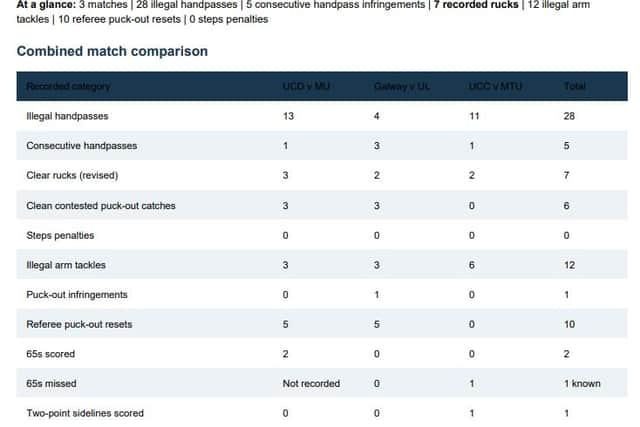
Across the three games involving UCD and Maynooth University, University of Galway and University of Limerick, and UCC and MTU Cork, there were just seven clear rucks recorded.
That is a remarkable statistic when you consider the nature of modern hurling, and even more so when you factor in the dreadful weather conditions in which some of these games were played.
And while some of the changes will undoubtedly need a bit of tweaking, the early signs are encouraging.
Handpassing and the disappearance of rucks
The handpass was always going to be one of the biggest talking points, and referee Chris Mooney certainly wasn't shy about pulling players for infringements in the opening trial between UCD and Maynooth University.
There were 13 illegal handpasses penalised in that game, followed by four in the Galway-UL encounter and another 11 in the UCC-MTU Cork meeting.
That brings the overall tally to 28 illegal handpasses, alongside five infringements of the new consecutive handpass rule.
Whether the differences between the matches are down to players adapting or variations in refereeing interpretations remains to be seen, but it has been refreshing to see the illegal handpass being properly enforced.
The biggest positive, however, has undoubtedly been the reduction in rucks.
Players appear far more reluctant to carry the ball into contact, knowing that they cannot simply handpass their way out of trouble through a succession of short exchanges.
Instead, they are looking to move the sliotar earlier, and that naturally leads to more striking and genuine contests for possession.
And the fact that just two rucks were recorded in the Galway-UL game, despite absolutely dreadful weather conditions, was particularly encouraging.
The return of genuine contests
That was probably the most enjoyable aspect of the opening game between UCD and Maynooth for me.
There were some brilliant deliveries into the forward lines, with long, accurate balls creating genuine man-on-man contests inside, and some excellent scores coming as a result.
Forwards were coming out, winning possession, taking on their markers and splitting the posts, and quite frankly, it was a joy to watch at times.
That side of hurling has become less and less common in recent years, with teams now so comfortable in possession that they can afford to bide their time, work their way out of tackles and wait until someone finds a pocket of space.
There is obviously plenty of skill involved in that approach, but it has taken away some of the genuine battles between forwards and defenders that were once such a prominent feature of the game.
The longer puck-outs have helped in that regard, with goalkeepers now required to send the ball beyond their own 45-metre line.
There were six clean catches from contested puck-outs across the three games, and while that is hardly an overwhelming number, it was refreshing to see players being forced to compete for possession rather than simply working the ball short.
Puck-out delays a concern
However, the longer puck-outs have also brought one of the more frustrating aspects of the new rules into focus.
There were five referee-ordered resets in the opening UCD-Maynooth game and another five in the Galway-UL encounter, although none were recorded in the UCC-MTU Cork meeting.
Under the new rules, three players from each team must be positioned between the 20-metre and 45-metre lines before the puck-out, and while I can understand the thinking behind it, it certainly slowed things down.
The requirement for goalkeepers to wait for the referee's whistle is another issue, particularly when a team might previously have been able to take a quick puck-out after a wide.
In fairness, referees are learning on the job here as well, and hopefully these delays will become less frequent as the trials progress.
Because the last thing hurling needs is more unnecessary stoppages.
Six steps must be enforced
The six-step rule was another one that attracted plenty of criticism when it was announced, but I have to say, I still think it could work.
The old four-step rule was completely outdated in terms of how the modern game is played.
Quite frankly, how often do we see players taking just four steps before releasing possession, particularly at inter-county level?
At least now, with six steps, there is a reasonable allowance for players to escape a tackle, create a bit of space and get their shot or pass away.
But the rule must be enforced.
There wasn't a single steps infringement penalised across the three games, and while the players appeared to adapt reasonably well in the opening encounter, there were several occasions during the Galway-UL game when players seemed to exceed the allowance without being pulled up.
There is little point in increasing the allowance from four steps to six if referees are simply going to continue allowing players to take seven, eight or nine.
Tackling and scoring changes
The illegal arm tackle is another area worth watching, with 12 infringements recorded across the three games, including six in the UCC-MTU Cork encounter alone.
Players can still use their arms when tackling, but they cannot pull or drag back an opponent's arm to prevent them from getting away.
Combined with the six-step allowance, that could encourage players to take on their opponents a bit more, which can only be a good thing.
As for the revised 65, I quite like the idea of making what has become a relatively routine scoring opportunity that bit more difficult.
Kilkenny's Michael Brennan demonstrated the striking ability of modern players by converting both awards in the opening game from the considerably longer distance.
The two-point sideline cut, on the other hand, is something I could take or leave.
There was a successful effort in the UCC-MTU Cork game, but I still don't think it is something hurling particularly needs.
We had a similar rule 20-odd years ago and it didn't stick around, and I would be surprised if this one survived either.
Plenty to build on
But that is the whole point of these trials.
Not every rule is going to work, and there is no harm in trying a few different things to see what improves the game and what doesn't.
Three games is still a very small sample size, and there is a long way to go before any definitive conclusions can be drawn.
The delays to restarts will need to be addressed, and there are certainly questions surrounding refereeing consistency, particularly when it comes to the steps rule.
But when you consider the reduction in rucks, the greater emphasis on striking and the return of genuine contests for possession, there is certainly reason to be optimistic.
If the objective is to clamp down on some of the more frustrating aspects of modern hurling while making the game a better spectacle, then these experiments have been a step in the right direction.